Read the Bhagavad Gita in 18 days
The Gita has 18 chapters, so a chapter a day takes 18 days. Chapters run from 20 verses (12 and 15) to 78 (chapter 18). A day’s reading takes 4 to 13 minutes in English, or 5 to 20 minutes to recite the Sanskrit.
You can start any day. For Gita Jayanti 2026, start on Thursday, 3 December and chapter 18 falls on Sunday, 20 December, the day tradition says the Gita was spoken.
Times assume about 10 seconds a verse for the English and 15 to recite the Sanskrit.
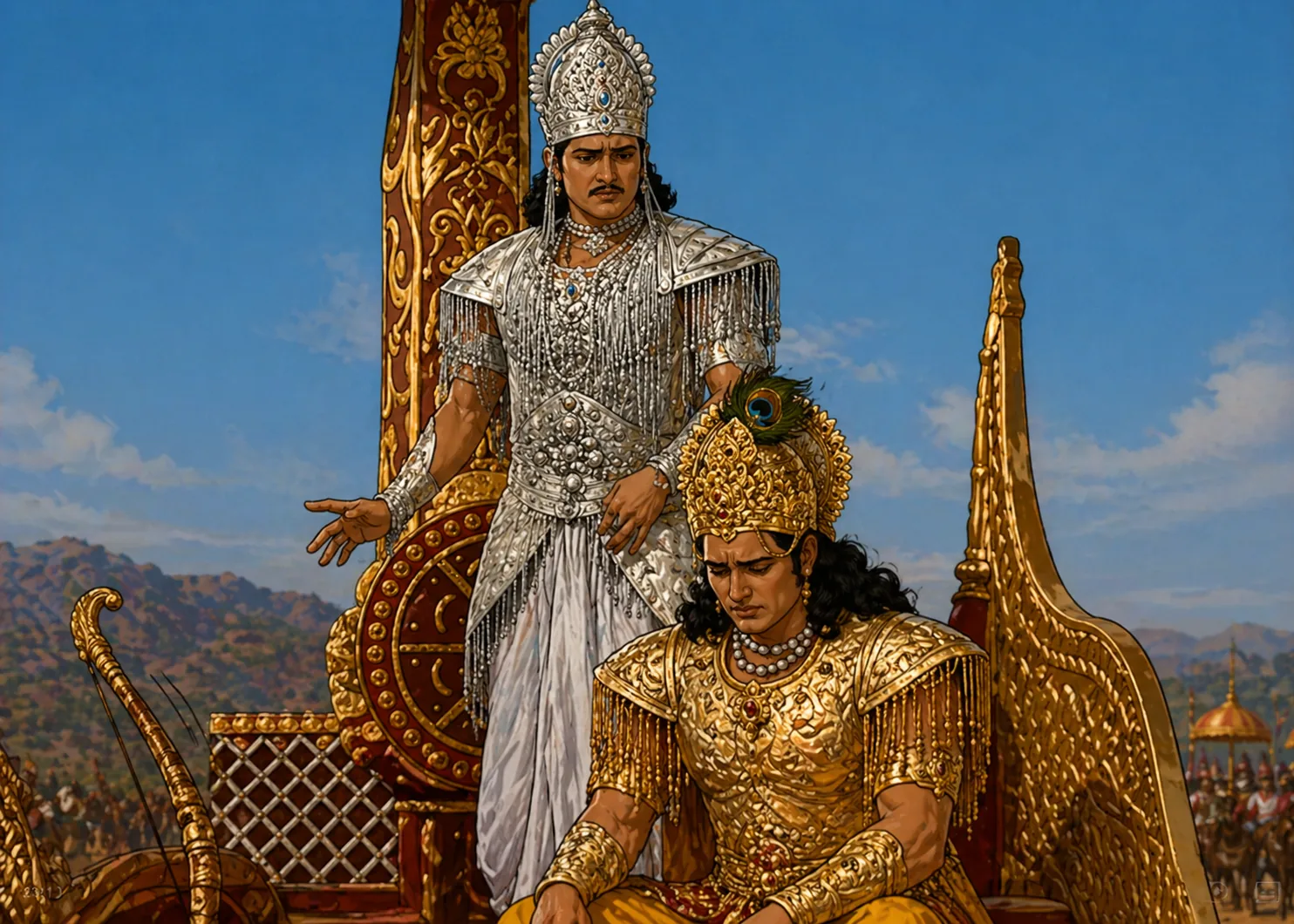
Chapter 1: The Yoga of Arjuna's DespairArjuna Vishada Yoga
The armies line up at Kurukshetra. Arjuna asks Krishna to drive the chariot between them, sees his grandfather Bhishma and his teacher Drona on the other side, and puts down his bow.
Read chapter 1 →1.47 · Sanjayaसञ्जय उवाचएवमुक्त्वाऽर्जुनः संख्ये रथोपस्थ उपाविशत् । विसृज्य सशरं चापं शोकसंविग्नमानसः ॥
“Sanjaya said: Saying this, Arjuna sat down on the chariot seat in the midst of the battlefield, casting aside his bow and arrows, his mind overwhelmed by grief.”
Chapter 2: The Yoga of KnowledgeSankhya Yoga
Krishna starts to answer. He speaks of the self that is never born and never dies, of doing your own work without holding on to the result, and ends with a portrait of a person whose mind stays steady.
Read chapter 2 →2.47 · Krishnaकर्मण्येवाधिकारस्ते मा फलेषु कदाचन । मा कर्मफलहेतुर्भूर्मा ते सङ्गोऽस्त्वकर्मणि ॥
“You have a right to action alone, never to its fruits. Do not become the cause of the result, and do not cling to inaction.”
Chapter 3: The Yoga of ActionKarma Yoga
Arjuna asks why he should act at all if knowledge is higher. Krishna says nobody can stay without acting for even a moment, and explains how to work without being bound by it.
Read chapter 3 →3.19 · Krishnaतस्मादसक्तः सततं कार्यं कर्म समाचर । असक्तो ह्याचरन्कर्म परमाप्नोति पूरुषः ॥
“Therefore, always perform your duty without attachment; by acting without attachment, a person reaches the supreme.”
Chapter 4: Knowledge and Renunciation of ActionJnana Karma Sanyasa Yoga
Krishna says he taught this yoga long ago to Vivasvan, and explains why he takes birth age after age.
Read chapter 4 →4.7 · Krishnaयदा यदा हि धर्मस्य ग्लानिर्भवति भारत । अभ्युत्थानमधर्मस्य तदाऽऽत्मानं सृजाम्यहम् ॥
“Whenever there is a decline of dharma and a rise of adharma, I manifest myself.”
Chapter 5: The Yoga of RenunciationKarma Sanyasa Yoga
Arjuna asks which is better, giving up action or acting without attachment. Krishna says both lead to the same place, and that of the two, acting without attachment is better.
Read chapter 5 →5.10 · Krishnaब्रह्मण्याधाय कर्माणि सङ्गं त्यक्त्वा करोति यः । लिप्यते न स पापेन पद्मपत्रमिवाम्भसा ॥
“One who offers actions to Brahman, renounces attachment, and acts is not stained by wrongdoing, just as a lotus leaf is untouched by water.”
Chapter 6: The Yoga of MeditationDhyana Yoga
Meditation: where to sit and how to hold the body and the mind. Arjuna says the mind is as hard to hold as the wind, and Krishna answers him.
Read chapter 6 →6.35 · Krishnaश्री भगवानुवाचअसंशयं महाबाहो मनो दुर्निग्रहं चलं । अभ्यासेन तु कौन्तेय वैराग्येण च गृह्यते ॥
“The mind is hard to control, but it is mastered through practice and detachment.”
Chapter 7: Knowledge and WisdomJnana Vijnana Yoga
Krishna describes his lower and higher nature, and says all things are strung on him like pearls on a thread.
Read chapter 7 →7.7 · Krishnaमत्तः परतरं नान्यत्किञ्चिदस्ति धनञ्जय । मयि सर्वमिदं प्रोतं सूत्रे मणिगणा इव ॥
“O Dhananjaya, nothing exists higher than Me. All this world is strung on Me like pearls on a thread.”
Chapter 8: The Imperishable AbsoluteAkshara Brahma Yoga
Arjuna asks seven questions, from what Brahman is to how Krishna is known at the time of death. Krishna answers with what a person remembers at the end.
Read chapter 8 →8.7 · Krishnaतस्मात्सर्वेषु कालेषु मामनुस्मर युध्य च । मय्यर्पितमनोबुद्धिर्मामेवैष्यस्यसंशयम् ॥
“Therefore, remember Me at all times and fight. With mind and intellect offered to Me, you will surely come to Me.”
Chapter 9: The Royal KnowledgeRaja Vidya Raja Guhya Yoga
Krishna calls this the royal knowledge, and says he accepts even a leaf or a little water offered with love.
Read chapter 9 →9.26 · Krishnaपत्रं पुष्पं फलं तोयं यो मे भक्त्या प्रयच्छति । तदहं भक्त्युपहृतमश्नामि प्रयतात्मनः ॥
“Whoever offers me a leaf, a flower, a fruit, or water with devotion, I accept that devoted offering from the pure-hearted.”
Chapter 10: The Yoga of Divine GloriesVibhuti Yoga
Arjuna asks where he should look for Krishna. Krishna lists his glories: among months Margashirsha, among rivers the Ganga, among the Pandavas Arjuna himself.
Read chapter 10 →10.20 · Krishnaअहमात्मा गुडाकेश सर्वभूताशयस्थितः । अहमादिश्च मध्यं च भूतानामन्त एव च ॥
“I am the Self, O Gudakesha, seated in the heart of all beings. I am the beginning, the middle, and the end of all beings.”
Chapter 11: The Universal FormVishvarupa Darshana Yoga
Arjuna asks to see Krishna’s universal form and is given the eyes to see it. What he sees frightens him, and he asks Krishna to take his familiar form again.
Read chapter 11 →11.32 · Krishnaश्री भगवानुवाचकालोऽस्मि लोकक्षयकृत्प्रवृद्धोलोकान्समाहर्तुमिह प्रवृत्तः । ऋतेऽपि त्वां न भविष्यन्ति सर्वेयेऽवस्थिताः प्रत्यनीकेषु योधाः ॥
“The Blessed Lord said: I am Time, the great destroyer of worlds, here to end all beings. Even without you, the warriors standing in the opposing ranks will not survive.”
Chapter 12: The Yoga of DevotionBhakti Yoga
Devotion. Krishna describes, quality by quality, the devotee who is dear to him.
Read chapter 12 →12.13 · Krishnaअद्वेष्टा सर्वभूतानां मैत्रः करुण एव च । निर्ममो निरहङ्कारः समदुःखसुखः क्षमी ॥
“One who hates no being, is friendly and compassionate, free from possessiveness and ego, equal in pleasure and pain, and forgiving.”
Chapter 13: Field and Knower of the FieldKshetra Kshetrajna Vibhaga
The body is the field, and the one who knows it is the knower of the field. Krishna separates the two.
Read chapter 13 →13.28 · Krishnaसमं सर्वेषु भूतेषु तिष्ठन्तं परमेश्वरम् । विनश्यत्स्वविनश्यन्तं यः पश्यति स पश्यति ॥
“One who sees the supreme being equally present in all beings, imperishable amid the perishing, truly sees.”
Chapter 14: The Three Modes of Material NatureGunatraya Vibhaga Yoga
Sattva, rajas and tamas: how each one binds a person, and how to tell which one is at work.
Read chapter 14 →14.5 · Krishnaसत्त्वं रजस्तम इति गुणाः प्रकृतिसंभवाः । निबध्नन्ति महाबाहो देहे देहिनमव्ययम् ॥
“Arjuna, the three qualities of nature—sattva, rajas, and tamas—bind the imperishable inner being to the body.”
Chapter 15: The Yoga of the Supreme PersonPurushottama Yoga
The world as an ashvattha tree with its roots above. Krishna names himself Purushottama, beyond both the perishable and the imperishable.
Read chapter 15 →15.1 · Krishnaश्री भगवानुवाचऊर्ध्वमूलमधःशाखमश्वत्थं प्राहुरव्ययम् । छन्दांसि यस्य पर्णानि यस्तं वेद स वेदवित् ॥
“The Blessed Lord said: They speak of the imperishable banyan-like tree of the world, with roots above and branches below. The Vedas are its leaves. One who knows this tree knows the Vedas.”
Chapter 16: The Divine and Demoniac NaturesDaivasura Sampad Vibhaga
Two sets of qualities, daivi and asuri. Krishna names desire, anger and greed as the three gates to ruin.
Read chapter 16 →16.21 · Krishnaत्रिविधं नरकस्येदं द्वारं नाशनमात्मनः । कामः क्रोधस्तथा लोभस्तस्मादेतत्त्रयं त्यजेत् ॥
“Desire, anger, and greed are the three gates of ruin. Abandon these three.”
Chapter 17: The Three Kinds of FaithShraddhatraya Vibhaga Yoga
Faith, food, sacrifice, austerity and giving, each described in three kinds.
Read chapter 17 →17.3 · Krishnaसत्त्वानुरूपा सर्वस्य श्रद्धा भवति भारत । श्रद्धामयोऽयं पुरुषो यो यच्छ्रद्धः स एव सः ॥
“O Bharata, each person's trust matches their inner nature. A person is made of trust; whatever trust he holds, that is what he becomes.”
Chapter 18: Liberation through RenunciationMoksha Sanyasa Yoga
Krishna gathers the teaching together, tells Arjuna to reflect on it and then choose, and Arjuna says his doubts are gone and he will act.
Read chapter 18 →18.63 · Krishnaइति ते ज्ञानमाख्यातं गुह्याद्गुह्यतरं मया । विमृश्यैतदशेषेण यथेच्छसि तथा कुरु ॥
“Thus I have explained to you the most secret wisdom. Reflect on it fully, and then do as you wish.”
Fewer than 18 days?
The Gita Jayanti reading plan fits the same 700 verses into 9 days, 3 days or the day itself, and can split them evenly from whatever day you start. If you only have one sitting, see which chapter to read on Gita Jayanti.
Questions about reading a chapter a day
Do I need to read the chapters in order?
It helps. Chapter 1 sets up the scene the rest answers, and later chapters refer back to ideas from chapters 2 to 6. If you only have a few days, see which chapters to pick first. Which chapters to pick →
What if I miss a day?
Read two chapters the next day. Chapters 5, 8, 12, 14, 15, 16 and 17 have under 30 verses each and are the easiest to double up with.
Which translation should I read alongside?
Every chapter here has the Sanskrit, a Hindi anuvad and an English translation. If you want a printed edition too, our comparison of English translations covers Gita Press, Easwaran, Prabhupada and others. Compare translations →
How long does the whole Gita take?
All 700 verses take about two hours to read in English at an unhurried pace, or about three hours to recite in Sanskrit. Spread over 18 days, that is between 4 and 13 minutes a day in English.
Or one verse a day, for what you’re facing
Tell Wisdom what’s going on and it picks a verse a day for seven days, with what each one means for you.
Week 1 is free. A few questions, about two minutes.