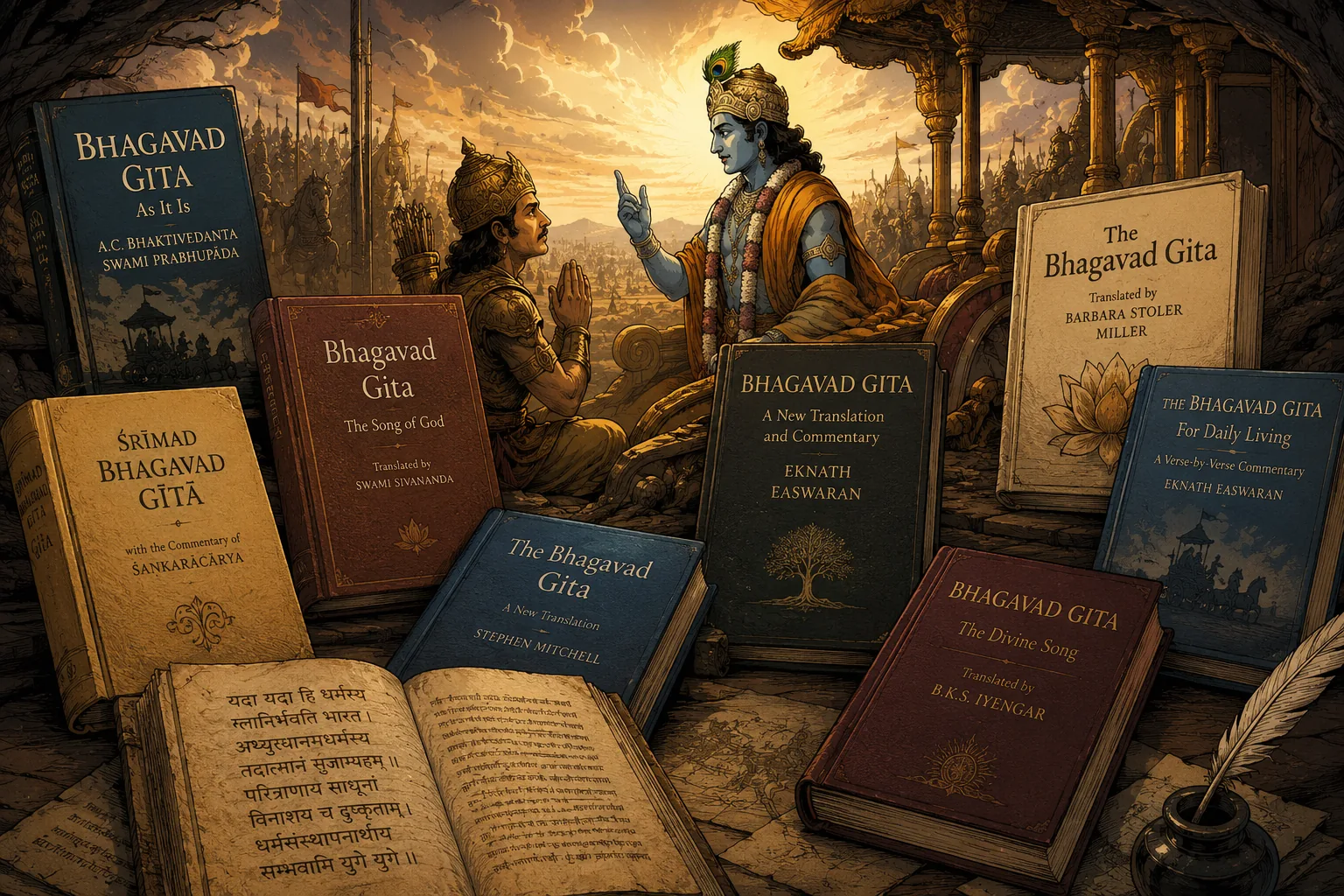
By 1982, two scholars named Callewaert and Hemraj had catalogued nearly 300 English translations of the Bhagavad Gita, out of almost 2,000 versions across some 75 languages. The count has only grown since. So the practical problem facing a modern reader is not access. It is choice. And most advice on this question fails in a predictable way: someone recommends the version their own tradition reads, without mentioning that it is a tradition's version at all.
This guide takes a different approach. It sorts the major translations and commentaries by the reader they were actually written for. Along the way it is honest about the trade-offs of each, because they all have trade-offs. Where a work has attracted documented criticism, that criticism is cited to the people who made it, alongside the tradition's own response. None of the judgments here are ours.
Why There Is No Neutral Gita
The Gita holds three great teachings in tension: karma (action), jnana (knowledge), and bhakti (devotion). Each has chapters where it appears supreme. Which one is the final teaching? The text lets you argue any of the three, and for over a thousand years, the greatest minds of Indian philosophy did exactly that.
Adi Shankara wrote the oldest surviving commentary in the 8th century and read the Gita as teaching liberation through knowledge alone. Ramanuja answered in the 11th century: the yogas of action and knowledge are real, but they culminate in devotion. Madhva read it as teaching the eternal distinctness of the atman and Bhagavan. Abhinavagupta, the Kashmir Shaiva master, read the battlefield itself as the war between knowledge and ignorance inside a person. Each of these is a complete, rigorous, sincere reading. Each is still followed today.
The tradition has a generous name for this: adhikāri-bheda, the recognition that different aspirants need different doors. A translation is never just a translation; it descends from one of these doors, or opens a new one. So the honest question is not “which Gita is correct?” It is “which door are you standing in front of?”
One Verse, Four Readings
Watch how much the door matters. Here is the Gita's climactic verse of surrender, the charama shloka, which Krishna speaks near the very end.
अहं त्वा सर्वपापेभ्यो मोक्षयिष्यामि मा शुचः ॥
ahaṃ tvā sarva-pāpebhyo mokṣayiṣyāmi mā śucaḥ ||
A translator has to pick one of these doors, or invent a diplomatic middle. There is no rendering of 18.66 that is innocent of interpretation. Keep that in mind as you read what follows.
If You Are Starting from Zero
Eknath Easwaran, The Bhagavad Gita
Across a decade of “which Gita should I read first?” threads on Reddit and Quora, one answer repeats more than any other. Easwaran grew up with the Gita in Kerala, taught English literature at the University of Nagpur, and later taught what is credited as the first accredited meditation course at a major American university, at Berkeley in 1968. His translation is clean modern English, and his chapter introductions quietly do the work a live teacher would.
Worth knowing It is not a literal translation, and it prints no Sanskrit. Reviewers have also pushed back on passages where Easwaran suggests the Gita anticipates modern physics. If you outgrow it, that is by design; it is a first Gita, and a very good one.
If you want something even gentler, Vinoba Bhave's Talks on the Gita is eighteen short talks, one per chapter, delivered to fellow prisoners in Dhule jail in 1932 and since translated into more than twenty languages. It is not a complete commentary, but generations of Indian readers met the Gita through it. New to the text itself? Our beginner's guide covers the Gita's structure before you commit to any edition.
If You Want the Text, Nothing Added
Bibek Debroy, The Bhagavad Gita
Debroy, who later translated the entire unabridged Mahabharata into ten volumes, made a deliberate choice here: strictly literal translation, notes pushed to the back, zero commentary in the text. Readers who distrust every lens praise exactly this. It is the closest thing to an unmediated Gita in modern English.
Worth knowing Literal means flat. There is no poetry here and no guidance, which is the point.
Winthrop Sargeant, The Bhagavad Gita
Sargeant was a New Yorker music critic who learned Sanskrit out of love for this text, and his edition gives every verse in Devanagari with each word's grammar and meaning laid out beneath it. You can watch every translation decision being made. Sanskrit self-learners and yoga teacher trainings have used it as the standard reference for four decades.
Worth knowing It is a study tool, not a reading Gita. The running translation at the foot of each page is serviceable, nothing more.
If You Practice in Hindi
Swami Ramsukhdas, Sadhak Sanjivani
Swami Ramsukhdas (1904–2005) refused to touch money, kept no ashram and no disciples in his own name, and asked that no biography of him be written. His life's Gita discourse became Sadhak Sanjivani, “the life-giving elixir for the aspirant”: every verse with word meanings, translation, and commentary that keeps turning the text toward one question, what does this mean for practice, today, in an ordinary household. It does not argue Advaita against Vishishtadvaita. Readers on Goodreads rate it near 4.65 and repeatedly use the same phrase for it: it leaves you free to think.
Worth knowing It is enormous, and its central themes return again and again by design; readers wanting brevity or literary polish find it demanding. It is a work of devotion, not academic scholarship, and its English translation keeps a heavily literal Indian-devotional register. Within its own terms, Hindi devotional readers widely consider it the greatest Gita commentary of the 20th century.
Gita Press publishes a full ladder beneath it: the pocket Gita with brief Hindi tika for daily patha, Jayadayal Goyandka's more compact and doctrinal Tattvavivechani for structured study, and a Hindi rendering of Shankara's bhashya for classical work. All of it is subsidized to cost almost nothing, which is why one of these sits in nearly every Hindi-speaking home.
If Devotion Is Your Path
A.C. Bhaktivedanta Swami Prabhupada, Bhagavad-gita As It Is
The most widely distributed Gita in history; the publisher counts over 23 million copies in more than 50 languages. Every verse carries Devanagari, transliteration, word-for-word glosses, translation, and a purport following the Gaudiya Vaishnava acharyas Vishvanatha Chakravarti and Baladeva Vidyabhushana. As a devotional Gita with a complete Sanskrit apparatus at a giveaway price, nothing else comes close.
Worth knowing The purports are the debated part. Hindu reviewers on forums like IndiaDivine, along with academic observers, have argued that they read specifically Gaudiya conclusions, including polemics against Advaita, into verses whose plain sense is broader. ISKCON's answer is direct: the purports transmit a real, centuries-old lineage faithfully, which is exactly what a traditional commentary is supposed to do. Both things can be true. Read the translation and word-glosses freely; read the purports knowing whose lineage voice they carry, which is how the tradition itself would want them read.
The classical root of the devotional reading is Ramanuja's 11th-century Gita Bhashya, available in a complete English edition by Swami Adidevananda (Sri Ramakrishna Math). Many scholars consider Ramanuja's reading closer to the Gita's plain devotional sense than any other classical commentary. For a modern scholarly take on the same current, Graham Schweig's The Beloved Lord's Secret Love Song translates the Gita as precisely that.
If You Want the Knowledge Reading
Swami Gambhirananda, Bhagavad Gita with the Commentary of Shankaracharya
The standard English access to the oldest surviving Gita commentary, translated by the 11th President of the Ramakrishna Order. Shankara's bhashya is where the entire commentarial tradition begins; every later school answers him. Reading it is a course in how Vedanta actually argues.
Worth knowing It is dense and assumes motivation. Scholars have also long debated whether Shankara's knowledge-alone reading subordinates the Gita's action teaching; Tilak built an entire book on that objection, and traditional Advaitins have answered him in turn. For the same teaching unfolded gently over thousands of pages, Swami Dayananda Saraswati's nine-volume Home Study Course is the modern teaching edition; Swami Chinmayananda's The Holy Geeta is the energetic applied version.
If You Believe the Gita Is About Action
Bal Gangadhar Tilak, Gita Rahasya
Tilak wrote his 1,200-page argument in a Burmese prison cell: the Gita's core teaching is energetic desireless action, nishkama karma yoga, and the renunciatory reading gets the text backwards. He argues through Mimamsa interpretive rules and compares Kant and Mill along the way. The book became the intellectual engine of the Gita's role in India's freedom movement. Gandhi read it in Yerwada jail, revered it, and disagreed with it; his own Gujarati Gita, Anasakti Yoga, reaches the opposite conclusion about violence from the same activist premise.
Worth knowing It is long, lawyerly, and openly polemical toward Shankara's school, a critique traditional Advaitins regard as unfair to a commentator writing in an entirely different debate. Read it as the strongest case for one side of a real argument.
If You Read for the Poetry
Barbara Stoler Miller, The Bhagavad-Gita: Krishna's Counsel in Time of War
The slim free-verse translation that owned American classrooms for a generation, by one of the great Sanskrit literary translators. Accurate, compact, inexpensive.
Worth knowing Her fixed English choices, “sacred duty” for dharma and “discipline” for yoga, flatten words the tradition treats as bottomless. A note on Stephen Mitchell's popular verse rendering: Mitchell is a gifted poet who, as he acknowledges, does not read Sanskrit and worked from earlier English translations. Kirkus and others have documented what gets lost. Enjoy it as poetry; do not cite it as the Gita.
Sant Jnaneshwar, Jnaneshwari
The oldest and still the most beloved vernacular Gita: roughly 9,000 Marathi verses unfolding the Gita's 700, composed, the tradition holds, when Jnaneshwar was about fifteen. It is sacred scripture to millions in the Warkari tradition and world literature by any standard. Where the Sanskrit commentaries argue, the Jnaneshwari sings; it ends not with a doctrine but with the Pasayadan, a prayer for the well-being of every creature.
Worth knowing English cannot carry the ovi music, and the poem expands far beyond the Sanskrit text, so it will not tell you what a given verse literally says. That was never its job.
A Sane Way to Own Gitas
After all of this, the practical advice compresses to one principle. Translation and commentary do different work, and most disappointment comes from using one where you needed the other. A literal text (Debroy, Sargeant) shows you what the Sanskrit says. A lineage commentary (Sadhak Sanjivani, Gambhirananda, Prabhupada) shows you what a living tradition has made of it. A literary rendering (Miller, the Jnaneshwari) shows you what the poem can do to a reader.
So own three: a text, a teacher, and a poem. Read the text first, straight through, in two or three sittings. Pick the teacher whose door matches your temperament, and let the criticisms above tell you what you are choosing, not what to avoid. The commentaries disagree because the Gita is deep enough to sustain the disagreement. Twelve centuries of India's best minds arguing over 700 verses is not a problem to be solved. It is the strongest endorsement a book has ever received.
One Verse Per Day
The Wisdom app delivers one verse from the Bhagavad Gita each morning — Sanskrit, transliteration, meaning, and modern relevance. Home screen widget. Free.