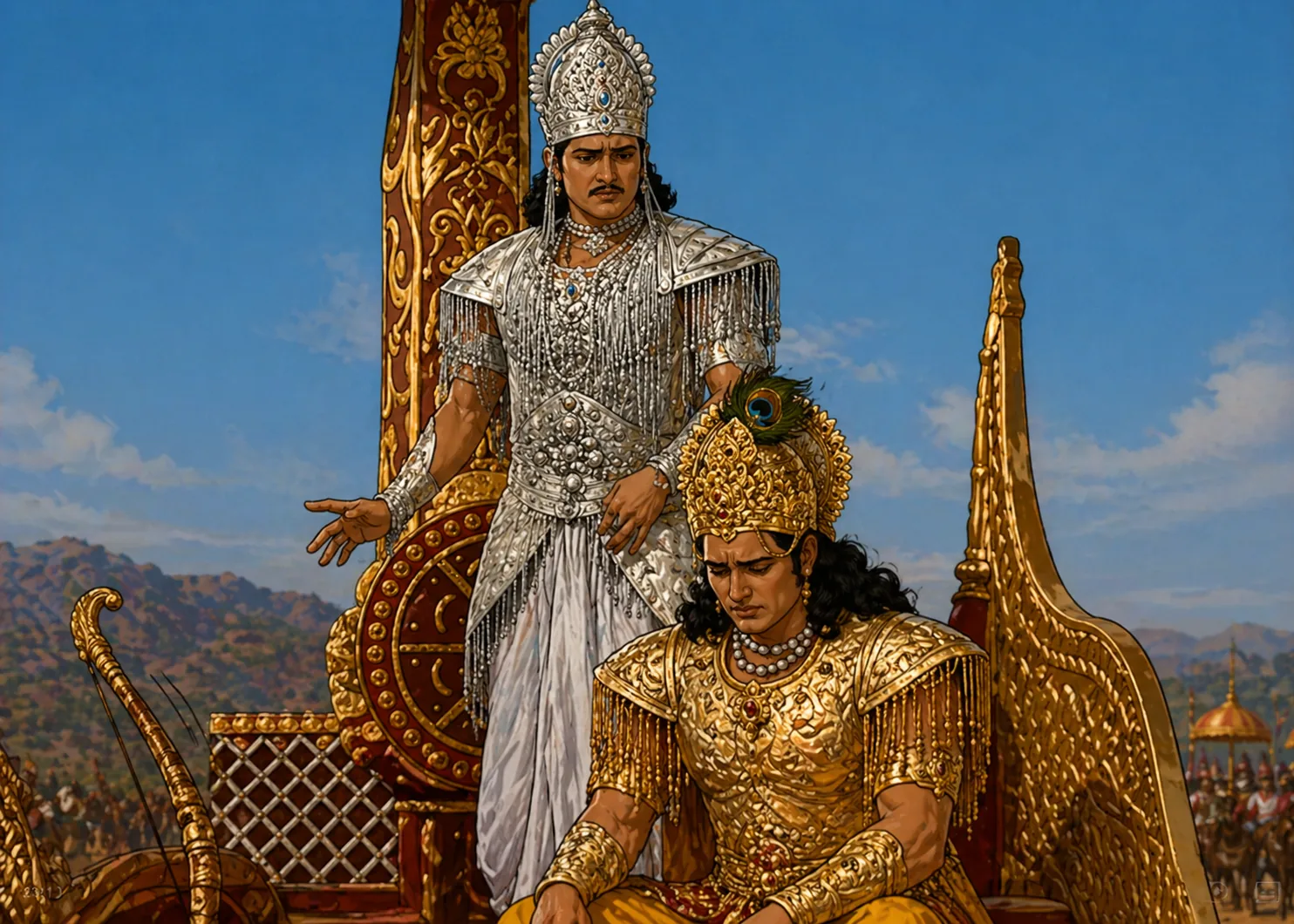
The Gita begins with a collapse, before any teaching. Forty-seven verses on a great archer who cannot raise his bow.
By Ankur Shukla·47 verses · Arjuna Vishada Yoga·~16 min read·Chapter 1 of 18·Wisdom translation, edited by Ankur Shukla. Commentary AI-drafted, human-reviewed. Reviewed October 2026. Methodology →
Chapter 1 often gets treated as backstory, the setup before the philosophy begins in Chapter 2. It deserves a slower reading, because it records a collapse in detail before any answer is given.
Arjuna is unsure whether fighting is right at all.
The setting is the battlefield of Kurukshetra, with two armies drawn up against each other. Between them stands Arjuna, trained since boyhood for this kind of moment and armed with the bow Gandiva. He finds he cannot fight.
47 verses later, he sits down in his chariot and puts his bow down.
The chapter that causes this is worth understanding in full.
Verse 1.1 · The Opening Question
The Blind King Asks First
The first words of the Bhagavad Gita belong to Dhritarashtra, the blind king, who sits far from the battlefield and asks his minister Sanjaya for a report.
Dhritarashtra said: O Sanjaya, after assembling on the holy field of Kurukshetra, eager to fight, what did mine and Pandu's sons do?
What it reveals
The first verse already holds the war's root cause. Dhritarashtra says māmakāḥ, mine, and sets his sons against Pandu's. The blind king has sorted the world into us and them before anything has happened.
“Dhritarashtra asks what his sons and Pandu's sons did at Kurukshetra.”
The word māmakāḥ matters. Dhritarashtra calls his sons simply "mine", a possessive English cannot carry with the same weight. In the Mahabharata he is a man who confuses ownership with love, and many readers take his blindness as more than physical.
The Gita also places this scene in dharma-kshetra, the field of righteousness. Kurukshetra was already a sacred site, and naming it the field of dharma frames the battle as a place where the question of what is right will be faced.
Verses 1.2–1.19 · The Armies Array
The Inventory of Warriors
Verses 2 through 19 are often skimmed: Duryodhana surveys the Pandava army and reports to his teacher Dronacharya. Warriors are named on both sides. Conches are blown. The battlefield reverberates with the sound of war drums, trumpets, and the collective cry of two armies that have been building toward this moment for thirteen years of exile and betrayal.
These verses set out what is at stake. When Arjuna's crisis comes, we understand its scale because we have been shown named people on both sides. Bhishma, grandsire to both sides. Dronacharya, who taught both armies. Karna, who, unknown to Arjuna, is his own elder brother. Every name is a relationship. Every warrior is someone's son, someone's teacher, someone's friend.
A note on Duryodhana: In verses 3–11, Duryodhana lists the Pandava warriors at length before naming his own. In 1.10 he calls his army aparyāptam, which some translators read as unlimited and others as insufficient. Read the second way, he is reassuring himself as much as his teacher.
Verse 1.20 · The Last Moment of Certainty
The Pause at the Precipice
In verse 20, with the conches blown and weapons about to clash, Arjuna, whose chariot flies the banner of Hanuman, raises his bow.
Seeing the sons of Dhritarashtra arranged and ready for battle, as the weapons were about to clash, Arjuna, the son of Pandu, whose chariot bore the monkey banner, lifted his bow.
The pivot
The bow is up, and in verses 21–23 Arjuna asks Krishna to halt the chariot between the armies so he can see whom he must fight. A careful warrior looks before he commits.
“Arjuna sees the Kauravas in battle order and raises his bow.”
There Arjuna saw, standing in both armies: fathers, grandfathers, teachers, maternal uncles, brothers, sons, grandsons, friends, fathers-in-law, and well-wishers. Seeing all these relatives arrayed on both sides, the son of Kunti was overwhelmed with great compassion.
The human moment
The list is personal: fathers, grandfathers, teachers, uncles, brothers, sons, grandsons, friends. An abstract enemy has turned into family, and Arjuna is overcome with pity (kṛpā).
“Arjuna sees family and teachers in both armies, and pity overwhelms him.”
Arjuna has faced death in battle before, so fear of dying is not what stops him. He can no longer tell which side he is on, because the people he loves stand in both armies: grandfathers, teachers and in-laws, about to kill each other.
His identity has been built on a network of relationships. When those relationships are about to be severed, by his own hand, the self built on them begins to dissolve.
"Seeing all these relatives arrayed on both sides, the son of Kunti was overwhelmed with great compassion."
sīdanti mama gātrāṇi mukhaṃ ca pariśuṣyati | vepathuśca śarīre me romaharṣaśca jāyate ||
Meaning
My limbs give way and fail. My mouth is drying up. My body trembles. My hair stands on end.
What he lists
Arjuna lists what is happening to his body: his limbs give way, his mouth goes dry, he trembles, his hair stands on end, his skin burns, and the bow slips from his hand (1.29–30). He says it comes from pity for his own people (1.28).
“Arjuna's limbs fail, his mouth dries, he trembles and his hair stands on end.”
na kāṅkṣe vijayaṃ kṛṣṇa na ca rājyaṃ sukhāni ca | kiṃ no rājyena govinda kiṃ bhogairjīvitena vā ||
Meaning
I do not want victory, Krishna. I do not want a kingdom or pleasures. Of what use is a kingdom to us, Govinda? Of what use are enjoyments or even life itself?
The inversion
Arjuna gives up victory, kingdom and pleasure, the three things warriors fight for, in a single verse. He is rejecting the reason they came to fight.
“Arjuna wants neither victory nor kingdom nor pleasure at this price.”
yeṣāmarthe kāṅkṣitaṃ no rājyaṃ bhogāḥ sukhāni ca | ta ime'vasthitā yuddhe prāṇāṃstyaktvā dhanāni ca ||
Meaning
Those for whose sake we desire kingdoms, pleasures, and happiness, they themselves stand here on this battlefield, having given up their desire for life and wealth.
The logic
The argument is about consequences: the people a victory would benefit are the ones who will die winning it. The means would consume the ends.
“The people they want the kingdom for are the ones standing ready to die.”
yadyapyete na paśyanti lobhopahatacetasaḥ | kulakṣayakṛtaṃ doṣaṃ mitradrohe ca pātakam || kathaṃ na jñeyamasmābhiḥ pāpādasmānnivartitum | kulakṣayakṛtaṃ doṣaṃ prapaśyadbhirjanārdana ||
Meaning
Even if those whose minds are blinded by greed cannot see the papa in destroying families and betraying friends, how can we, who clearly see the consequences, fail to turn away from this papa, O Janardana?
The ethics
Arjuna argues from duty: if you can see the harm and others cannot, you carry more responsibility for acting on what you see. The argument has force. Krishna's reply in Chapter 2 is about who Arjuna takes himself to be.
“Those who see the wrong in destroying a family should turn away from it.”
Arjuna is right that destroying families has consequences for generations, that those who see harm more clearly bear more responsibility, and that a victory built on killing people you love would feel hollow.
Krishna's answer is that the arguments are incomplete. They rest on what the Gita later calls ahamkara, the ego-self built around roles, relationships and outcomes, and the next 17 chapters are about the self beneath it.
If the armed sons of Dhritarashtra were to kill me in battle, unresisting, unarmed, even that would be better for me.
Choosing to die unarmed
Arjuna would rather be killed unarmed and unresisting than fight his own family. It is a principled position, and Krishna spends the following chapters arguing that it comes from confusion.
“Arjuna says he would rather die unarmed than fight his kinsmen.”
Sanjaya said: Having spoken thus on the battlefield, Arjuna sat down upon the seat of his chariot, casting aside both bow and arrows, his mind overwhelmed with grief.
The end of Chapter 1
Sanjaya reports this to the blind king. Chapter 1 ends with Arjuna sitting down in the chariot, his bow and arrows set aside (1.47).
“Arjuna sits down in the chariot, drops bow and arrows, and gives way to grief.”
Sanjaya's narration ends here. Chapter 1's last image is Arjuna, seated, bow and arrows set aside, mind overwhelmed with grief, śokasaṃvignamānasaḥ. The compound word is worth sitting with:shoka (grief) + samvigna (agitated, disturbed) +manasah (of the mind): a mind shaken by grief.
What This Chapter Is Really Doing
Why Vyasa Spent 47 Verses on the Crisis
The Gita could have begun at Chapter 2, with Krishna teaching from the first sign of doubt. Vyasa spends 47 verses on the collapse before any teaching appears.
An answer that comes before the question has weight tends not to land. By the time Krishna begins, Arjuna is fully in his confusion, in body, mind, ethics and grief.
Many readers find the same with their own questions. You can read about the self, detachment, duty and the atman and follow it all in your head, and it starts to matter when your sense of who you are has been shaken.
In Krishna's reading, Arjuna's mistake is to confuse his roles with his self. He is a grandson, a student, a friend and a warrior, and when those roles collide he has nothing deeper to steer by. His grief belongs to a self built on circumstances, facing circumstances it cannot handle.
What Krishna teaches from Chapter 2 onward is how to find the self that is not built on circumstances at all.
"My nature is overcome by pity and weakness, and my mind is confused about dharma. Tell me for certain what is better. I am your student; I take refuge in you. Teach me."
Arjuna, Bhagavad Gita 2.7
What Bhagavad Gita Chapter 1 teaches, 5 core insights
Attachment distorts perception. The Gita's very first line, a blind king asking "what did mine do?", shows that attachment shapes the questions we ask before we even begin to act.
In the Gita, grief comes before wisdom.Arjuna's vishada (despondency) names the chapter, and his breakdown is where the teaching starts.
The body registers moral crisis before the mind does.In 1.29–1.30, Arjuna describes trembling, dry mouth, burning skin, and a bow slipping from his hand, all before he makes a single argument.
A coherent ethical argument can still be rooted in the wrong identity.Arjuna's case against fighting is reasoned, and it is built on attachment to roles (son, student, friend) rather than on a deeper understanding of the self. That is what Krishna addresses in Chapter 2.
The question matters as much as the answer. Vyasa spends 47 verses on the crisis before Krishna teaches anything.
All 47 Verses, Quick Reference
Bhagwat Geeta Adhyay 1, All 47 Shlokas at a Glance
All 47 verses of Arjuna Vishada Yoga (Bhagavad Gita Chapter 1), organised by speaker and theme:
Verses
Speaker
What Happens
1.1
Dhritarashtra
The blind king's opening question, "mine and Pandu's sons"
1.2–11
Duryodhana / Sanjaya
Duryodhana surveys Pandava army, reports to Drona, assesses both forces
1.12–19
Sanjaya
Bhishma blows his conch; both armies respond with war cries and instruments
1.20–23
Sanjaya / Arjuna
Arjuna lifts his bow, then asks Krishna to place the chariot between the armies
1.24–25
Sanjaya
Krishna positions the chariot; Arjuna sees the armies arrayed
1.26–27
Sanjaya
Arjuna recognises relatives on both sides, overcome with compassion
1.28–46
Arjuna
Arjuna's grief, physical symptoms, ethical arguments, final refusal
1.47
Sanjaya
Arjuna sets down his bow. Chapter 1 ends.
Revised October 2026: corrected Karna's relation to Arjuna (Arjuna does not know Karna is his brother), replaced a pseudo-medical reading of 1.29–30 with what the verses say, removed superlatives about Arjuna and the chapter, fixed verse taglines that did not match their verses (including 1.46), and updated the Chapter 2 link; copy edited.
About the Wisdom App
What is the Wisdom app?
Wisdom is an iPhone app that tunes the Bhagavad Gita to your life. You say how you feel and what is going on, and it picks the verse that speaks to it, with the original Sanskrit, a plain English meaning and what it says for you. Then it builds a 7-day plan around your situation, read aloud, drawing on the Gita, the Ramayana and the Mahabharata. Today's shloka also sits on your Home Screen and Lock Screen.
Wisdom is for people who want the Gita's answer to the week they are having. Week 1 is free on theApple App Store.
Did you like this article?
Frequently Asked Questions
Bhagavad Gita Chapter 1, Common Questions
What is Bhagavad Gita Chapter 1 about?
Bhagavad Gita Chapter 1, called Arjuna Vishada Yoga, describes the scene on the battlefield of Kurukshetra just before the great war begins. Arjuna sees his relatives and teachers arrayed on both sides, is overcome with grief and moral doubt, and ultimately sets down his bow and refuses to fight. The chapter sets up the ethical crisis that makes Krishna's teachings in the chapters that follow both necessary and meaningful.
What does "Arjuna Vishada Yoga" mean?
Arjuna Vishada Yoga means the yoga of Arjuna's grief, or the yoga of Arjuna's despondency. In Sanskrit, vishada means deep sorrow or distress, and yoga here means a path or discipline. The title implies that Arjuna's grief itself is a doorway: his collapse is what opens the space for Krishna's teaching.
How many verses are in Chapter 1 of the Bhagavad Gita?
Bhagavad Gita Chapter 1 has 47 verses (shlokas). None of Krishna's teaching appears yet, but the chapter sets up the situation that the remaining 17 chapters answer.
Why does Arjuna refuse to fight in Chapter 1?
Arjuna refuses to fight because he sees his own relatives, grandfathers, teachers, uncles, brothers, friends, arrayed on both sides of the battlefield. He argues that victory is meaningless if it requires killing the people he loves, that destroying families unravels the ethical fabric of society, and that dying unarmed would be preferable to this. His arguments are serious ones, though they are rooted in attachment to his roles as a son, student, and friend rather than to his duty as a warrior.
What physical symptoms does Arjuna describe in Chapter 1?
In verses 1.29–1.30, Arjuna describes his limbs going weak, his mouth drying up, his body trembling, his hair standing on end, his skin burning all over, his famous bow Gandiva slipping from his hands, and his mind reeling in confusion. He says the cause is pity for his own people (1.28).
Who speaks first in the Bhagavad Gita?
The very first words of the Bhagavad Gita are spoken by King Dhritarashtra, the blind father of the Kauravas. He asks his advisor Sanjaya what happened after both armies assembled on the battlefield of Kurukshetra. The Gita opens with a question, and the question already shows a father's attachment to his own sons.
What does "dharma-kshetra kuru-kshetra" mean?
The opening line of the Bhagavad Gita describes Kurukshetra as dharma-kshetra, the field of dharma, or the field of righteousness. Calling the battlefield a field of dharma frames what follows as an argument about duty, conscience and action as well as a war story.
How important is Bhagavad Gita Chapter 1?
Chapter 2 is typically considered the philosophical heart of the Gita, and later chapters go deeper into yoga, devotion, and metaphysics. Chapter 1 sets up the crisis the teaching answers, and Krishna's replies in later chapters respond to the specific doubts Arjuna raises here.
What does the Bhagavad Gita say about grief?
The Bhagavad Gita takes grief seriously, it opens with it. Arjuna's despondency in Chapter 1 is the starting point of the whole dialogue. The Sanskrit word vishada (grief or despondency) appears in the title of Chapter 1 itself, and Krishna's first teaching, in 2.11, answers that grief directly.
What is the most famous shloka in Bhagavad Gita Chapter 1?
Chapter 2 holds the verses people cite most often, such as 2.47. From Chapter 1, commonly quoted shlokas include 1.1 (the opening question), 1.29–1.30 (Arjuna's physical symptoms), and 1.32, "I do not desire victory, nor kingdom, nor pleasures." Verse 1.47, where Arjuna sets down his bow, closes the chapter and is often quoted too.