20 Famous Sanskrit Shlokas — with Meaning in Hindi and English
Twenty short verses that carry the compressed wisdom of a civilisation. From the Ganesha invocation to the peace mantra of the Isha Upanishad — in accurate Devanagari, IAST, English, and Hindi.
By Ankur Shukla·20 Shlokas · 5 Themes·~18 min read·Wisdom translation, edited by Ankur Shukla. Commentary AI-drafted, human-reviewed. Published July 2026. Methodology →
Twenty shlokas, five themes: what an educated Indian should carry by heart
A Sanskrit shloka is a small, precise thing. Thirty-two syllables. Four quarter-lines. And often, inside that compression, an idea large enough to organise a life. The verses in this article have travelled across three thousand years because they say more per syllable than almost any language has ever managed. Memorising a handful of them is one of the most durable gifts you can give yourself.
What follows is not a random collection. These twenty shlokas are the ones an educated Indian, or anyone drawn to the Sanskrit tradition, ought to know by heart. Four opening prayers. Five verses from the Bhagavad Gita. Four Upanishadic statements on wisdom and truth. Three on devotion and the guru. Four on peace and blessing. For each verse you will get the Devanagari, the IAST transliteration, an English translation, the Hindi meaning, and one or two lines on where the verse comes from and how it is used.
How to read this article
You do not have to memorise all twenty at once. Pick one shloka per week, chant it aloud twice a day, and by the end of five months you will carry all twenty in your body. The verse you recite becomes the verse that arrives when you actually need it — before a difficult meeting, at the bedside of a sick parent, on the morning of an exam, or in the small hours when the mind will not settle.
What Makes a Shloka a Shloka
The word shloka (श्लोक) originally meant “fame” or “praise” in Vedic Sanskrit. In classical usage it came to mean the standard verse form of Sanskrit epic and philosophical poetry. Its most common metre is the anushtubh: thirty-two syllables arranged in four quarters (called padas) of eight syllables each. The Ramayana, the Mahabharata, and the Bhagavad Gita are almost entirely composed in this metre.
The anushtubh has rules about where long and short syllables can fall, but the rules are flexible enough that ordinary speech can be shaped into it. That flexibility is why the metre became the workhorse of Sanskrit literature. It carries philosophy, story, prayer, satire, and law with equal grace. Not every famous Sanskrit verse is a shloka in the strict metrical sense — some of the Vedic verses in this article are in the older Gayatri metre or the Trishtubh, and the Upanishadic Om Purnamadah is prose — but in ordinary speech people call any short Sanskrit verse a shloka, and that is the sense used here.
What matters practically is that these verses were designed for oral transmission. The rhythm makes them easy to memorise, and the memorisation is not incidental to their power. A shloka you have carried in the body for years arrives on its own when the situation calls for it. This is why the tradition insists on chanting, not just reading.
The 20 Shlokas Every Educated Person Should Know
The verses are grouped in five thematic sections. Within each group the arrangement moves roughly from the most universally known to the more specialised. Read one, chant it out loud, sit with its meaning, then move to the next.
Part I: Opening Prayers (Mangalacharan)
Every new beginning in the Sanskrit tradition — a book, a class, a ritual, a journey — opens with a mangalacharan, an auspicious invocation. These four are the ones you will hear most often in ordinary Hindu life.
vakratuṇḍa mahākāya sūryakoṭi samaprabha | nirvighnaṃ kuru me deva sarvakāryeṣu sarvadā ||
Translation
O Lord with the curved trunk and the great body, whose radiance equals a thousand million suns, remove all obstacles from my path in every undertaking, always.
Context & Use
The single most recited shloka in Hindu life. Chanted at the start of any new venture — a book, a wedding, a business, a school year. Ganesha is the Vighnaharta, the remover of obstacles, and this verse is the shortest, most complete request for his blessing.
“Before you begin anything, ask for the obstacles to fall away.”
हिन्दी अर्थ
हे टेढ़ी सूँड़ और विशाल शरीर वाले, करोड़ों सूर्यों के समान तेज वाले भगवान गणेश! कृपया मेरे सभी कार्यों में सदा विघ्न-बाधाओं को दूर कीजिए।
oṃ saha nāvavatu | saha nau bhunaktu | saha vīryaṃ karavāvahai | tejasvi nāvadhītamastu mā vidviṣāvahai || oṃ śāntiḥ śāntiḥ śāntiḥ ||
Translation
Om. May we be protected together. May we be nourished together. May we work together with great vigour. May our study be radiant and effective. May we never quarrel. Om, peace, peace, peace.
Context & Use
The classical prayer chanted by teacher and student together before a lesson. It asks not for individual excellence but for shared protection, shared nourishment, and the absence of enmity between the two who study. It is a definition, in prayer form, of what teaching actually is.
“Let us study together, without rivalry, and prosper together.”
ॐ, हम दोनों (गुरु और शिष्य) की एक साथ रक्षा हो, हमारा एक साथ पालन-पोषण हो। हम एक साथ मिलकर पूरे उत्साह से कार्य करें। हमारा अध्ययन तेजस्वी बने। हममें कभी परस्पर द्वेष न हो। ॐ शान्ति, शान्ति, शान्ति।
Om. Lead me from the unreal to the real. Lead me from darkness to light. Lead me from death to immortality. Om, peace, peace, peace.
Context & Use
One of the oldest and most famous Upanishadic prayers, known as the Pavamana mantra. It is the shortest complete summary of the spiritual life — a movement from illusion to truth, from ignorance to wisdom, from mortality to what does not die. Chanted daily by many Vedantins as their first prayer of the morning.
“From the false to the real. From darkness to light. From death to what does not die.”
oṃ bhūrbhuvaḥ svaḥ | tat savitur vareṇyaṃ bhargo devasya dhīmahi | dhiyo yo naḥ pracodayāt ||
Translation
Om, across earth, atmosphere, and heaven. Let us meditate on that most excellent radiance of the divine Sun, who may inspire our understanding.
Context & Use
The mother of the Vedas, given at the sacred thread ceremony (upanayana) and traditionally recited at dawn, noon, and dusk. Twenty-four syllables in the Gayatri metre, addressed to Savitr — the vivifying aspect of the Sun. Its subject is not asking for anything material; it is asking that our very intelligence be illumined.
“Let the light of the divine Sun awaken our understanding.”
ॐ, भूः (पृथ्वी), भुवः (अन्तरिक्ष) और स्वः (स्वर्ग) — इन तीनों लोकों में व्याप्त उस सविता देव (सूर्य) के श्रेष्ठ तेज का हम ध्यान करते हैं, जो हमारी बुद्धि को प्रेरित करे।
Part II: From the Bhagavad Gita
The Bhagavad Gita contributes more famous shlokas to daily Indian speech than any other text. These five are the ones most often quoted, chanted, and printed on the back of trucks.
karmaṇyevādhikāraste mā phaleṣu kadācana | mā karmaphalaheturbhūrmā te saṅgo'stvakarmaṇi ||
Translation
You have the right to action alone, never to its fruits. Do not let the fruit of action be your motive. And do not become attached to inaction.
Context & Use
The signature verse of the Bhagavad Gita and, arguably, the most quoted line in all Indian philosophy. It compresses the entire teaching of karma yoga into a single shloka. Note the fourth line: Krishna anticipates the misreading that says 'if I should not want results, why act?' and blocks it in advance.
“Perform your action. Release the fruit. Do not disengage.”
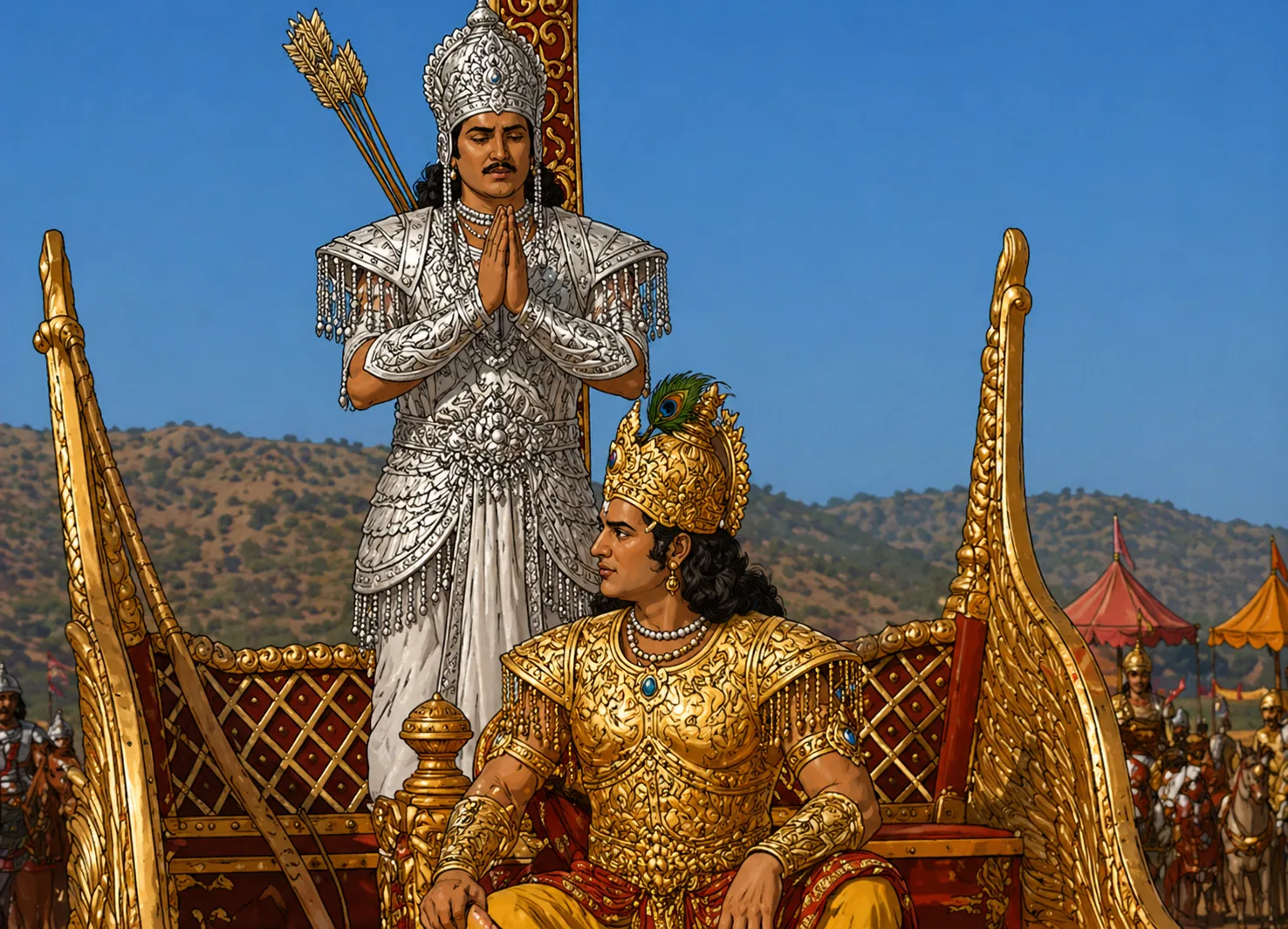
Whenever there is a decline of dharma, O Bharata, and a rise of adharma, then I manifest myself.
Context & Use
Krishna's declaration of the divine promise. This verse and the next (4.8) are the classical scriptural basis for the doctrine of avatara — the divine descent into the world when righteousness is threatened. Chanted at the beginning of Ramayana and Krishna festivals across India.
For the protection of the good, for the destruction of evildoers, for the firm establishment of dharma, I take birth age after age.
Context & Use
The immediate continuation of 4.7 and often chanted together with it. Note the three infinitives: protection, destruction, establishment. The avatara is not only a saviour of the good but an active restorer of the order that has been broken. This is the verse that gave Indian devotional life its endlessly renewable hope.
“I return, age after age, to protect the good and restore dharma.”
sarvasya cāhaṃ hṛdi sanniviṣṭo mattaḥ smṛtir jñānam apohanaṃ ca | vedaiśca sarvair aham eva vedyo vedāntakṛd vedavid eva cāham ||
Translation
I am seated in the hearts of all beings. From me come memory, knowledge, and their loss. I alone am to be known through all the Vedas. I am the author of Vedanta, and I am also the knower of the Vedas.
Context & Use
One of Krishna's most explicit statements of his indwelling nature. It is chanted before meals in many households as part of the Vaishnava tradition — a reminder that the giver, the food, and the eater are all held within the same divine presence. Also central to the Upanishadic teaching that Bhagavan is not distant but seated in the heart.
“The divine is seated in every heart, and every scripture points there.”
मैं सब प्राणियों के हृदय में स्थित हूँ। मुझसे ही स्मृति, ज्ञान और उनका लोप होता है। सब वेदों के द्वारा जानने योग्य मैं ही हूँ। वेदान्त का रचयिता और वेदों को जानने वाला भी मैं ही हूँ।
Abandon every dharma and take refuge in me alone. I will free you from all papa. Do not grieve.
Context & Use
Traditional commentators call this the charama shloka — the ultimate verse of the Bhagavad Gita. After seventeen chapters of instruction about action, knowledge, meditation, and devotion, Krishna's final word is a release: let go of every framework you have been holding, take refuge, and do not grieve.
“Let go of every framework. Take refuge. Do not grieve.”
सभी धर्मों (कर्तव्यों) का परित्याग करके तुम केवल मेरी शरण में आओ। मैं तुम्हें सब पापों से मुक्त कर दूँगा। शोक मत करो।
Part III: On Wisdom and Truth
These four are the great Upanishadic and Vedic statements — the sentences that Indian philosophy has been unpacking for three thousand years. Some are quoted daily by politicians and journalists without any awareness of their source; all four repay a lifetime of contemplation.
satyam eva jayate nānṛtaṃ satyena panthā vitato devayānaḥ | yenākramanty ṛṣayo hyāptakāmā yatra tat satyasya paramaṃ nidhānam ||
Translation
Truth alone triumphs, not untruth. By truth is laid out the path of the gods, along which the sages, their desires fulfilled, ascend to where the supreme treasure of truth is placed.
Context & Use
The first three words, satyameva jayate, are the national motto of the Republic of India, inscribed at the base of the Ashoka emblem. Note that the full verse makes truth not only a moral principle but a road — the path along which the rishis themselves have travelled to the highest reality.
ayaṃ nijaḥ paro veti gaṇanā laghucetasām | udāracaritānāṃ tu vasudhaiva kuṭumbakam ||
Translation
‘This one is mine, that one is a stranger’ — such calculation belongs to the small-minded. For those of noble character, the whole earth is one family.
Context & Use
Inscribed in the Parliament House of India and quoted by every Prime Minister at some point. Notice the moral architecture: it is not simply a sentimental claim about universal brotherhood. It is a distinction between two kinds of character — the small mind that classifies, and the udara (noble, expansive) mind that includes.
“The whole earth is one family — for those large enough to feel it.”
‘यह अपना है, यह पराया है’ — ऐसा भेदभाव संकीर्ण बुद्धि वालों के मन में होता है। उदार चरित्र वाले लोगों के लिए तो सम्पूर्ण पृथ्वी ही एक परिवार है।
Rig Veda 1.164.46
एकंसद्विप्राबहुधावदन्तिअग्निंयमंमातरिश्वानमाहुः॥
ekaṃ sad viprā bahudhā vadanti agniṃ yamaṃ mātariśvānam āhuḥ ||
Translation
Truth is one; the wise speak of it by many names. They call it Agni, Yama, Matarishvan.
Context & Use
The oldest statement of religious pluralism in world literature, sitting inside the Rig Veda itself. Vivekananda quoted this line at the 1893 Parliament of Religions in Chicago, and it has been the intellectual foundation of Hindu tolerance of many paths ever since. The reality is one — the vocabularies are many.
One of the four mahavakyas — the great utterances — of the Upanishads. It is the recognition by the seer Vamadeva that his own essential nature is not different from the ultimate reality. It is not a boast; it is the culmination of jnana yoga. Adi Shankaracharya built his entire philosophy on this single sentence.
“What I fundamentally am is not different from what everything fundamentally is.”
The guru is Brahma. The guru is Vishnu. The guru is the Lord Maheshwara. The guru is verily the supreme Brahman. To that revered guru, I bow.
Context & Use
Chanted daily at the start of any traditional class in music, dance, Sanskrit, or philosophy. Its logic is bold: the teacher is not merely a representative of the divine but, in the moment of teaching, the divine itself. Also chanted on Guru Purnima, the summer full moon dedicated to the teacher.
“The one who removes your ignorance is, at that moment, the divine itself.”
हिन्दी अर्थ
गुरु ही ब्रह्मा हैं, गुरु ही विष्णु हैं, गुरु ही महेश्वर हैं। गुरु ही साक्षात् परब्रह्म हैं। उन श्री गुरुदेव को मेरा नमस्कार है।
tvameva mātā ca pitā tvameva tvameva bandhuśca sakhā tvameva | tvameva vidyā draviṇaṃ tvameva tvameva sarvaṃ mama deva deva ||
Translation
You alone are mother and father. You alone are relative and friend. You alone are knowledge and wealth. You alone are everything to me, O Deva of devas.
Context & Use
One of the most emotionally direct devotional verses in the Sanskrit tradition. Its rhetorical device is the repetition of tvameva — 'you alone' — through every human role of intimacy and support. Chanted at the close of aartis and in bhajans across sects.
“Every relationship of shelter — parent, friend, teacher — is finally the one Divine.”
हिन्दी अर्थ
तुम ही माता हो, तुम ही पिता हो। तुम ही बन्धु हो, तुम ही सखा हो। तुम ही विद्या हो, तुम ही धन हो। हे देवों के देव! तुम ही मेरे सर्वस्व हो।
At the tip of the hand dwells Lakshmi. In the middle of the hand dwells Saraswati. At the base of the hand dwells Govinda. Therefore, in the morning, look upon your hands.
Context & Use
The verse most Hindu children learn first, taught by grandmothers to fold into the morning. Look at your palms before your feet touch the floor. The tip earns; the middle knows; the base blesses. It is a whole philosophy of work compressed into eight syllables per line.
“Before the day begins, look at the hands that will do it.”
हिन्दी अर्थ
हाथ के अग्रभाग में लक्ष्मी का वास है, मध्य भाग में सरस्वती का, और मूल भाग में गोविन्द (विष्णु) का। इसलिए प्रातःकाल उठकर अपने हाथों के दर्शन करने चाहिए।
Part V: On Peace and Blessing
The final four are prayers for the world — the shanti mantras with which Sanskrit tradition closes any reading, any lesson, any book.
May all beings be happy. May all be free from illness. May all see what is auspicious. May no one suffer.
Context & Use
Perhaps the most beloved shanti mantra in modern Hindu practice. Chanted at the close of every yoga class in the world and at the end of most Sanskrit gatherings. Notice its structure: four universal wishes, ending with the negative form — that no one, anywhere, be assigned a share of suffering.
“Let everyone, everywhere, be well.”
हिन्दी अर्थ
सभी सुखी हों। सभी रोगमुक्त हों। सभी का कल्याण हो। किसी को भी दुःख न मिले।
Traditional Blessing Mantra
ॐलोकाःसमस्ताःसुखिनोभवन्तु॥
oṃ lokāḥ samastāḥ sukhino bhavantu ||
Translation
Om. May all the worlds be happy.
Context & Use
Shorter and broader than the previous verse — a single line that reaches beyond humans to all beings, all realms, all worlds. Popularised globally through Ashtanga yoga, where it is chanted at the close of practice. In traditional Sanskrit usage it is the shortest complete benediction available.
“May every world, and every being in it, be happy.”
Om. That is whole. This is whole. From the whole, the whole emerges. When the whole is taken from the whole, the whole alone remains. Om, peace, peace, peace.
Context & Use
The shanti mantra of the Isha, Brihadaranyaka, and several other Upanishads. It is a mathematical impossibility rendered as a philosophical statement: an infinity from which an infinity is subtracted still equals infinity. The Upanishad is defining what wholeness (purnam) actually means — that which is not diminished by anything given or removed.
“The whole gives rise to the whole. When the whole is subtracted from the whole, wholeness remains.”
हिन्दी अर्थ
ॐ, वह (परब्रह्म) पूर्ण है, यह (जगत्) भी पूर्ण है। पूर्ण से ही पूर्ण की उत्पत्ति होती है। पूर्ण में से पूर्ण को निकाल लेने पर भी पूर्ण ही शेष रहता है। ॐ शान्ति, शान्ति, शान्ति।
Traditional Closing Mantra
ॐशान्तिःशान्तिःशान्तिः॥
oṃ śāntiḥ śāntiḥ śāntiḥ ||
Translation
Om. Peace, peace, peace.
Context & Use
The invariant closing of every Vedic recitation and every Upanishadic peace mantra. Traditional commentators explain the threefold repetition as a prayer for peace on three planes: adhidaivika (from divine or cosmic forces beyond our control), adhibhautika (from other beings and the material world), and adhyatmika (from within our own body and mind).
“Peace from the cosmos. Peace from other beings. Peace within.”
हिन्दी अर्थ
ॐ, शान्ति हो, शान्ति हो, शान्ति हो। (तीनों प्रकार के दुःखों — दैविक, भौतिक और आध्यात्मिक — से शान्ति की प्रार्थना।)
Twenty verses. Four invocations, five from the Gita, four on truth, three on the guru, four for peace. If you carried only these into a lifetime of Sanskrit, you would be carrying most of what the tradition considers indispensable.
How to Memorize Sanskrit Shlokas
Sanskrit shlokas were designed to be carried in the body, not stored on a page. The traditional method of memorisation has almost nothing in common with the way most modern students try to learn them. Here is what actually works.
Chant aloud, do not read silently. Sanskrit is a phonetic language. The shloka is not fully in you until your mouth knows it. Chant each new shloka out loud, at half your normal speaking pace, twice in the morning and twice at night for a week.
Learn the meter, not just the words. Notice where the eight-syllable padas break. Feel the rhythm before you worry about the meaning. Almost every anushtubh has the same underlying pulse, and once your body feels it, new shlokas take far less effort to acquire.
Read the IAST alongside the Devanagari. The romanised transliteration with diacritics tells you exactly where the long vowels and retroflex consonants fall. If you only learn from an ordinary English spelling, you will chant the shloka wrong for the rest of your life.
Meaning first, then the verse. Understand what the verse is saying in your own language before you try to memorise the Sanskrit. Memory holds meaning much more easily than sound. This is the opposite of how most rote learning is taught in schools.
Recite one shloka a day. Consistency beats intensity. One verse a day for twenty days, then those same twenty verses cycled once a week for a month, and you will have them for the rest of your life. Every commute, every walk, every waiting room becomes practice.
One Shloka a Day
If you want a simple, phone-based way to do the practice above, the Wisdom app was built for exactly this. Each morning it delivers one Sanskrit shloka — from the Gita, the Upanishads, or the great stotras — with the Devanagari, the IAST transliteration, the English meaning, a short commentary on how the verse applies to modern life, and a home screen widget so the verse waits for you every time you unlock your phone.
Start with the twenty in this article. Then let the app deliver the next one tomorrow, and the one after that, and by the end of a year you will have carried several hundred shlokas across the year with you.
Did you like this article?
Frequently Asked Questions
What is a shloka in Sanskrit?
A shloka (श्लोक) is the standard verse form of classical Sanskrit poetry. Its most common metre is the anushtubh: 32 syllables arranged in four quarters (padas) of eight syllables each. The Bhagavad Gita, the Ramayana, and much of the Mahabharata are composed in this metre. The shloka is designed for oral memorisation — the rhythm makes it possible to carry the text in the body across a lifetime.
What is the difference between a shloka and a mantra?
A shloka is a verse; a mantra is a formula. Every mantra can be recited, but not every shloka is a mantra. Mantras (like the Gayatri or Om Namah Shivaya) are considered to carry power in their sound itself, often revealed to a rishi and used for meditation or ritual. Shlokas are compositions — they carry meaning, story, philosophy. The Gayatri is both: a verse from the Rig Veda used as a mantra.
What is the easiest Sanskrit shloka to learn first?
For most learners, Vakratunda Mahakaya — the Ganesha invocation — is the natural first shloka. It is short, rhythmically clear, culturally familiar, and it is the traditional opening prayer before any new endeavour. Guru Brahma, Guru Vishnu is also very common as a second shloka. Both fit in four short lines and are easy to chant aloud once a day.
How do I pronounce Sanskrit shlokas correctly?
Sanskrit pronunciation follows precise rules: long and short vowels differ, aspirated and unaspirated consonants differ, and each syllable is enunciated fully. The IAST transliteration (with diacritics) tells you exactly where the long vowels and retroflex consonants are. Start by listening to a trained reciter for each shloka on the Wisdom app or a reliable recording, then chant along slowly for a week before speeding up. Do not learn Sanskrit pronunciation from an ordinary romanised spelling — it will teach you the wrong sounds.
Which is the most powerful Sanskrit shloka?
“Powerful” is tradition-dependent. The Gayatri Mantra is the most universally revered — it is the mantra given at the sacred thread ceremony and considered the mother of the Vedas. The Mrityunjaya mantra (Om Tryambakam Yajamahe) is invoked for healing and long life. From the Gita, BG 18.66 (sarva-dharman parityajya) is called the charama shloka — the ultimate verse. Ultimately, the shloka you actually recite daily becomes the powerful one for you.
Why do English translations of the same shloka differ so much?
Sanskrit is dense. A single word can carry multiple technical meanings — dharma, karma, yoga, atman have no clean English equivalents. Translators must choose between literal, philosophical, or devotional readings. Older translations (Max Muller, Radhakrishnan) tend toward the philosophical; devotional lineages (Iskcon, Chinmaya) tend toward the theological; modern academic ones aim for the literal. Reading two or three translations side by side is the fastest way to see the actual range of the verse.