Arjuna, when rajas and tamas are subdued, sattva rises. When sattva and tamas are subdued, rajas rises. When sattva and rajas are subdued, tamas rises.
— Krishna
❋
Bhagavad Gita · 14.10
Hindi · हिन्दी
हे भरतवंशोद्भव अर्जुन रजोगुण और तमोगुणको दबाकर सत्त्वगुण सत्त्वगुण, और तमोगुणको दबाकर रजोगुण, वैसे ही सत्त्वगुण और रजोगुणको दबाकर तमोगुण बढ़ता है ॥
The three qualities keep replacing one another. When one becomes stronger, the others are pushed down.
02
On the battlefield
Context & commentary
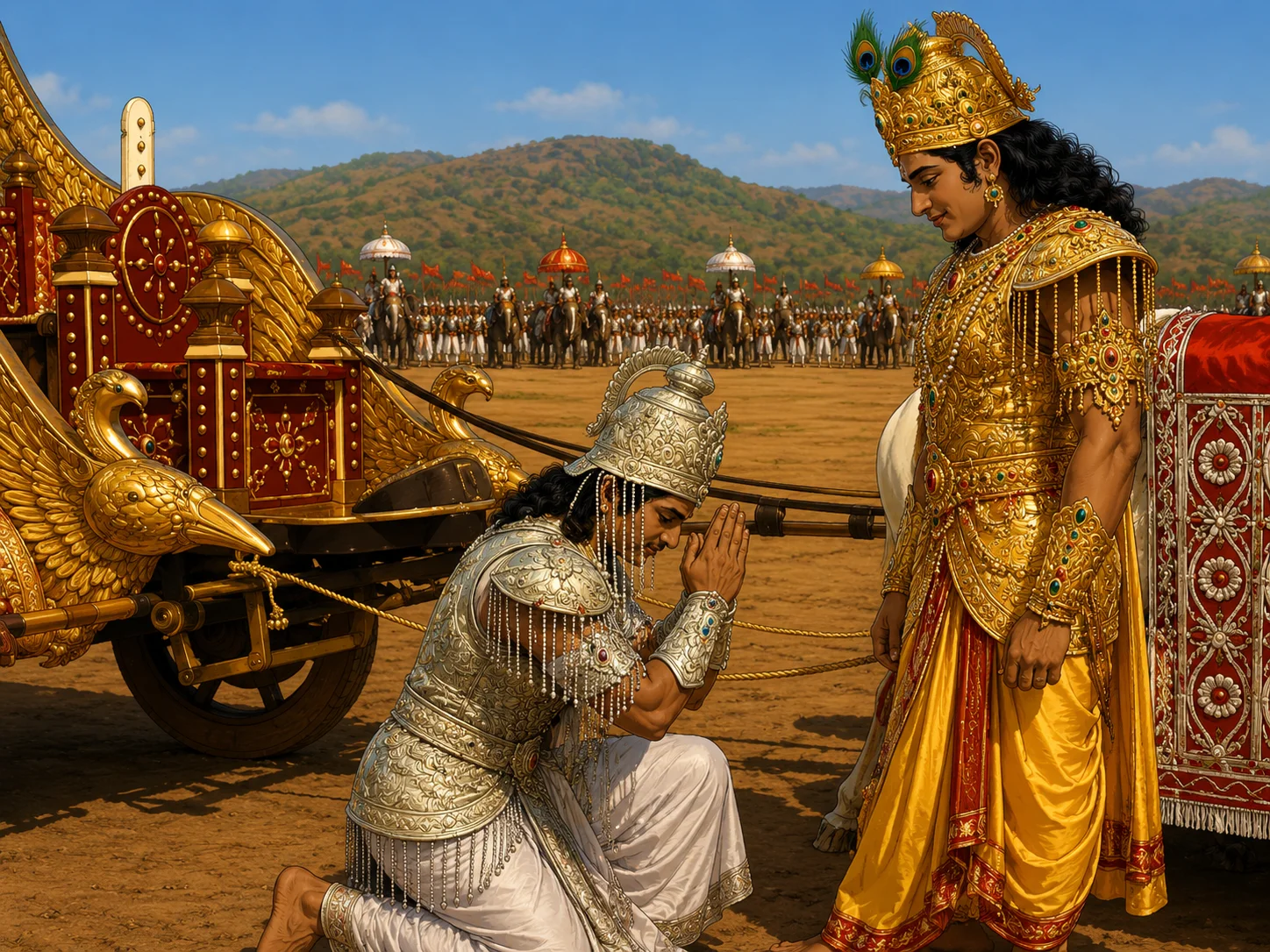
On Kurukshetra, Arjuna is still frozen while Krishna explains how the three qualities shape every mind and action. This verse adds the moving pattern: one quality rises only by suppressing the others, showing that inner states are always in flux.
03
In your life
Why this verse still matters
You wake up sharp, then drift into fog by noon, then feel restless at night. The mind is not one fixed mood — it keeps changing hands.
The takeaway
“You can stop treating your moods as permanent. What dominates now will not stay forever.”
It teaches you to notice which quality is currently leading, instead of mistaking a passing state for your nature.
What this verse means
The three qualities keep replacing one another. When one becomes stronger, the others are pushed down.
Context & commentary
On Kurukshetra, Arjuna is still frozen while Krishna explains how the three qualities shape every mind and action. This verse adds the moving pattern: one quality rises only by suppressing the others, showing that inner states are always in flux.
Why this verse still matters
You wake up sharp, then drift into fog by noon, then feel restless at night. The mind is not one fixed mood — it keeps changing hands.
“You can stop treating your moods as permanent. What dominates now will not stay forever.”
Explore related themes: gunas (47 verses), sattva (26 verses), rajas (21 verses)