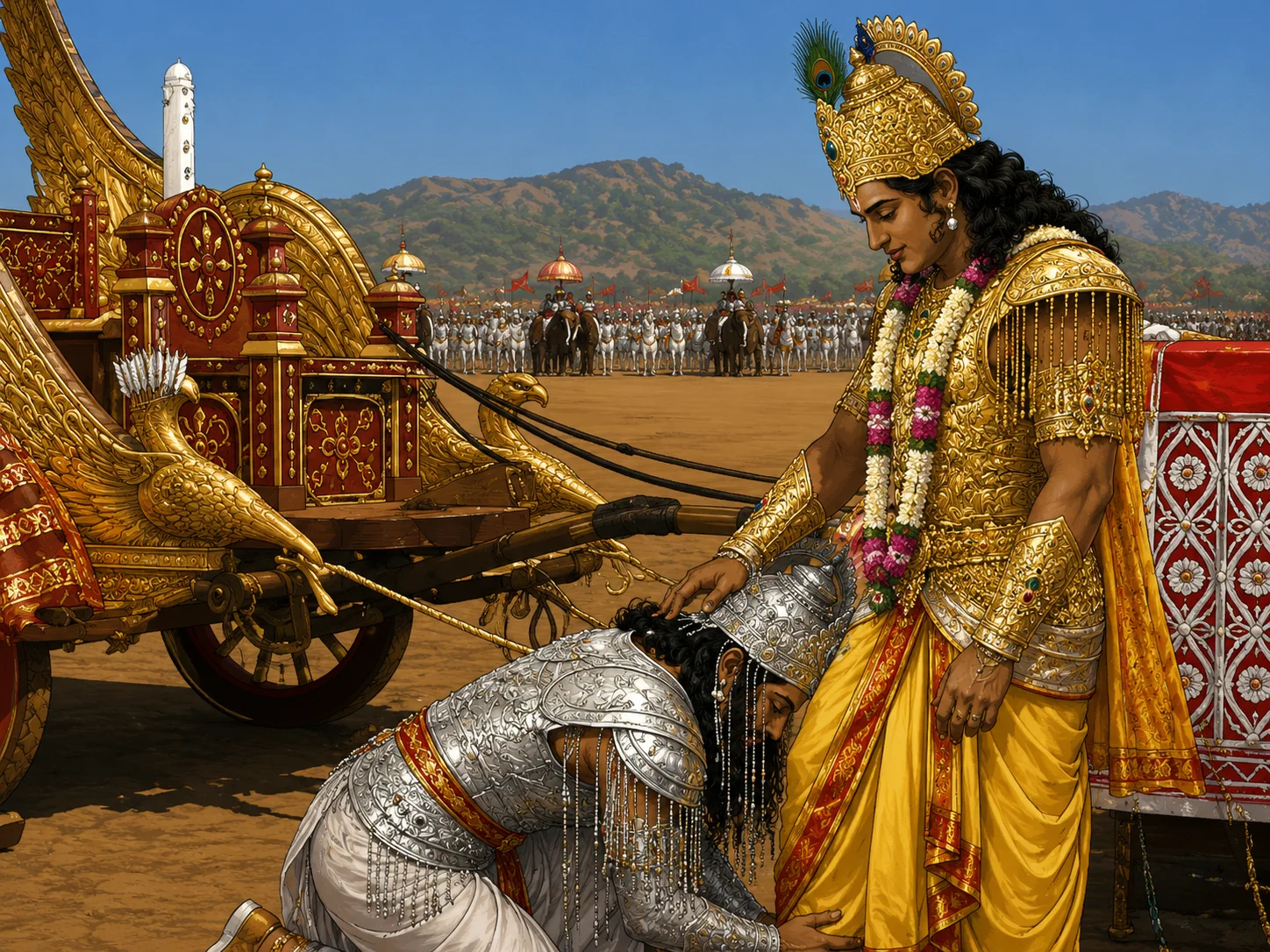
Bhagavad Gita for new beginnings: 7 verses to start well
For the new job, new city, new project or new chapter. Read one a day, or all seven before day one.
- 7 verses
- Gita, then the Chhandogya Upanishad
- About 14 min to read
- Sanskrit, English, audio
Krishna has advice for anyone at the start of something: for the one beginning, action is the way (6.3). These verses take you through a start. Every new thing comes with flaws, like fire with smoke (18.48). With steady effort it's within reach (6.36), so keep doing the work (3.19), cut through doubt (4.42) and step up (11.33). The last is from the Chhandogya Upanishad, a boy who walked off with four hundred thin cows and came back with a thousand.
The seven verses
- Verse 1See itBeginners begin by doingGita 6.3
- Verse 2What's underneathEvery start has smokeGita 18.48
- Verse 3SteadyWithin reachGita 6.36
- Verse 4SteadyKeep doing the workGita 3.19
- Verse 5DoCut the doubtGita 4.42
- Verse 6DoStep into your partGita 11.33
- Verse 7A storyFour hundred thin cowsChhandogya Upanishad 4.4.5
Beginners begin by doing
योगारूढस्य तस्यैव शमः कारणमुच्यते ॥
For one starting out on the path, action is the way. For one who has arrived, stillness is.
Bhagavad Gita 6.3 · Krishna
Full translation
For the sage who seeks to rise into yoga, action is the means. For the one who has risen in yoga, stillness is the means.
जो योगसमता में आरूढ़ होना चाहता है, ऐसे मननशील योगीके लिये कर्तव्यकर्म करना कारण कहा गया है और उसी योगारूढ़ मनुष्यका शम शान्ति परमात्मप्राप्तिमें कारण कहा गया है ॥
What it means for you
Krishna separates two stages. At the start, the way forward is action: showing up, practising, trying. Calm comes later, once you've arrived. A new beginning is a time to move.
Try this
Do one concrete thing for your new start today, before you plan anything else.
Every start has smoke
सर्वारम्भा हि दोषेण धूमेनाग्निरिवावृताः ॥
Don't abandon work that suits you just because it has flaws. Every undertaking has some, like fire has smoke.
Bhagavad Gita 18.48 · Krishna
Full translation
O son of Kunti, one should not abandon one's natural duty, even if it has flaws. All undertakings are clouded by some defect, just as fire is veiled by smoke.
हे कुन्तीनन्दन दोषयुक्त होनेपर भी सहज कर्मका त्याग नहीं करना चाहिये क्योंकि सम्पूर्ण कर्म धुएँसे अग्निकी तरह किसीनकिसी दोषसे युक्त हैं ॥
What it means for you
Krishna's image is fire and smoke. Every new job, city or project will come with things that don't work. That's normal, and Krishna asks you to keep going when you hit them.
Try this
Write down the first thing that went wrong in your new start. Then write the next step anyway.
This answers perfectionism. If a place is harming you, leaving can be the right call.
Within reach
वश्यात्मना तु यतता शक्योऽवाप्तुमुपायतः ॥
Without self-control it's hard. With sincere effort and the right means, it's within reach.
Bhagavad Gita 6.36 · Krishna
Full translation
Yoga is hard to attain for one whose mind is not fully controlled. But for one who controls the mind and strives with the right method, it can be reached.
जिसका मन पूरा वशमें नहीं है, उसके द्वारा योग प्राप्त होना कठिन है । परन्तु उपायपूर्वक यत्न करनेवाले वश्यात्माको योग प्राप्त हो सकता है, ऐसा मेरा मत है ॥
What it means for you
Krishna is honest: this takes discipline. He's also clear that with sincere effort and the right method, it can be done. New things feel hard because they're new.
Try this
Pick one habit that will make your new start work, and do it daily for a week.
Keep doing the work
असक्तो ह्याचरन्कर्म परमाप्नोति पूरुषः ॥
So keep doing the work that needs doing, well and without clinging. That's how you rise.
Bhagavad Gita 3.19 · Krishna
Full translation
Therefore, always perform your duty without attachment; by acting without attachment, a person reaches the supreme.
इसलिये तू निरन्तर आसक्तिरहित होकर कर्तव्यकर्मका भलीभाँति आचरण कर क्योंकि आसक्तिरहित होकर कर्म करता हुआ मनुष्य परमात्माको प्राप्त हो जाता है ॥
What it means for you
After the excitement of the first day comes the long middle. Krishna's advice is plain: keep doing what needs doing, well, without obsessing over how it will turn out.
Try this
Do today's work as if it were your first day.
Cut the doubt
छित्त्वैनं संशयं योगमातिष्ठोत्तिष्ठ भारत ॥
Cut the doubt in your heart with clear understanding, then stand up and act.
Bhagavad Gita 4.42 · Krishna
Full translation
Therefore, O Bharata, cut away this doubt in your heart, born of ignorance, with the sword of knowledge. Stand in yoga and rise up for battle.
इसलिये हे भरतवंशी अर्जुन हृदयमें स्थित इस अज्ञानसे उत्पन्न अपने संशयका ज्ञानरूप तलवारसे छेदन करके योग समता में स्थित हो जा, और युद्धके लिये खड़ा हो जा ॥
What it means for you
Arjuna's doubts didn't go away on their own. Krishna tells him to cut them with understanding: get clear on what you know, then stand up. Doubt will visit any new start. You don't have to wait for it to leave.
Try this
Write your biggest doubt about this new start, and one fact that answers it.
Step into your part
मयैवैते निहताः पूर्वमेवनिमित्तमात्रं भव सव्यसाचिन् ॥
The story is already in motion. Rise and do your part; be the instrument.
Bhagavad Gita 11.33 · Krishna
Full translation
Therefore, rise and win fame. Conquer your enemies and enjoy a prosperous kingdom. They have already been slain by me; become only the instrument, Arjuna.
इसलिये तुम युद्धके लिये खड़े हो जाओ और यशको प्राप्त करो तथा शत्रुओंको जीतकर धनधान्यसे सम्पन्न राज्यको भोगो । ये सभी मेरे द्वारा पहलेसे ही मारे हुए हैं । हे सव्यसाचिन् तुम निमित्तमात्र बन जाओ ॥
What it means for you
Krishna tells Arjuna the larger story is already moving, and his job is to rise and play his part well. Starting something new means you've joined something bigger than you.
Try this
Introduce yourself to one person in your new place who will matter to your work.
Being the instrument still means you choose and answer for what you do.
Four hundred thin cows
Given four hundred weak cows, he said, 'I won't come back until they are a thousand.' He stayed years.
Chhandogya Upanishad 4.4.5
Satyakama Jabala
Young Satyakama wanted to study, but he didn't know his father's lineage. He told the teacher exactly what his mother had told him. The teacher accepted him for that honesty and handed him four hundred weak, thin cows to look after. Satyakama said he wouldn't come back until they were a thousand. He spent years in the forest, and returned with a thousand cows and a mind that nature itself had taught.
Start honestly, start small, and stay with it.
What it means for you
Satyakama began with very little: no lineage, thin cows and a long road. Your start may look small too. What he did next is what counted.
Try this
Set your own 'thousand cows' goal for this new chapter, and write it down.
That's all seven.
Come back to the one that stayed with you. Or let Wisdom pick seven verses for your own situation, with the Sanskrit read aloud.
Common questions
Which Bhagavad Gita verse is good for a new beginning?
6.3 says that for someone starting out, action is the way. 18.48 reminds you that every new undertaking has flaws, like fire has smoke, and 4.42 asks you to cut doubt and stand up.
What does the Gita say about starting a new job?
Keep doing the work well without clinging to results (3.19), don't drop work that suits you because it has flaws (18.48), and play your part in the larger whole (11.33).
Is there a Gita verse for courage to start?
4.42 ends with uttiṣṭha: cut the doubt in your heart and stand up. 11.33 opens the same way: rise and do your part.
Should I read one verse a day or all seven at once?
Either works. All seven take about 14 minutes. One a day gives each verse time to settle, and the page remembers where you stopped.