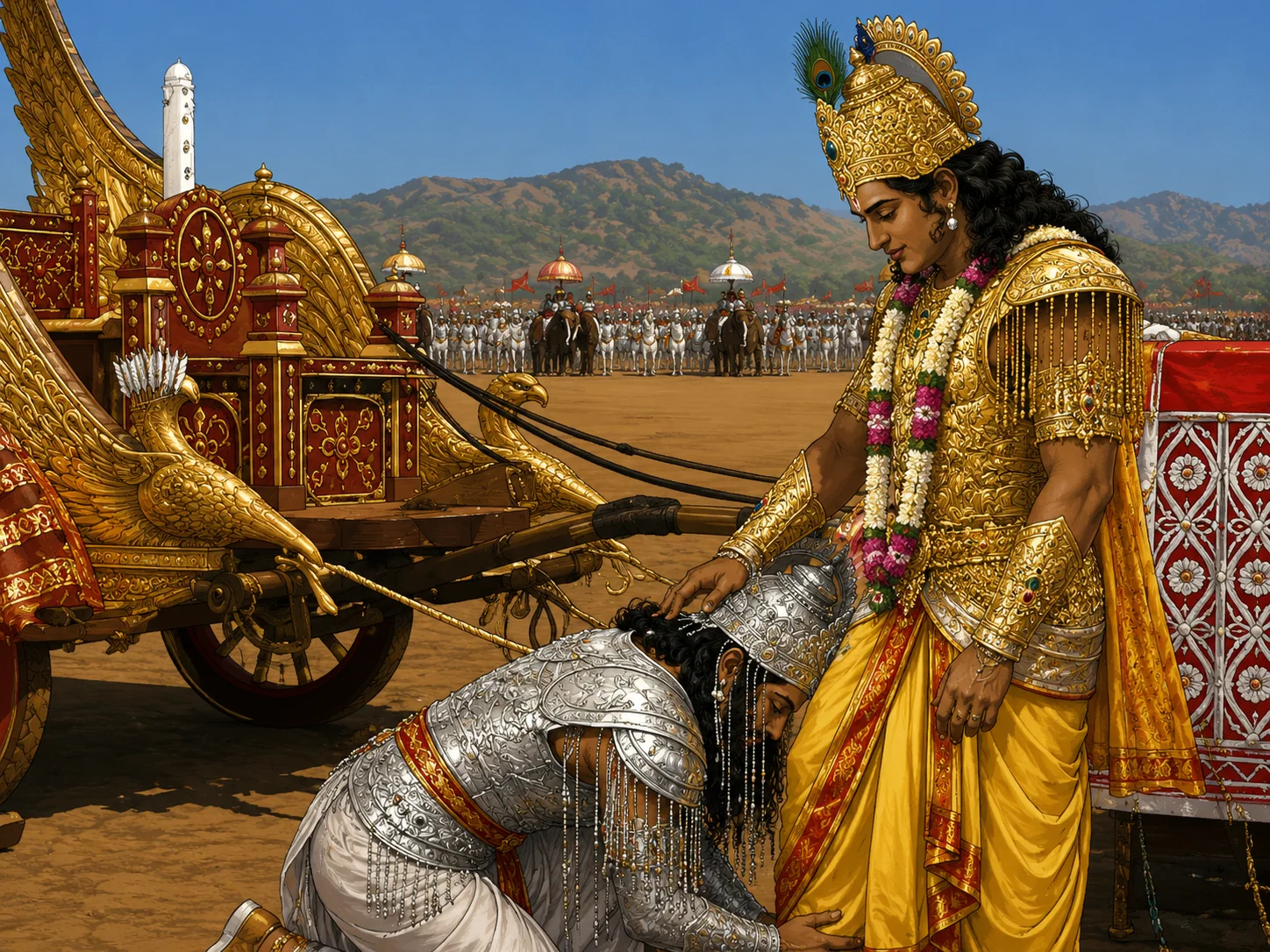
Chapter 12 follows the cosmic form of Chapter 11 the way silence follows a thunderclap. After 55 verses of overwhelming theophany, the Gita's next chapter is the shortest in the entire book — only 20 verses — and almost domestic in tone. Krishna stops describing his vast metaphysical body and starts describing what a person who loves him actually looks like, day to day. The chapter is, in a way, the Gita's quiet answer to the question Chapter 11 raised: now that you have seen the largeness, what does ordinary life look like?
The chapter opens with a question Arjuna has been holding for some time. Which is better — to worship the Divine as a form, with all the warmth of relationship, or to worship the formless absolute? Krishna's answer is gentler and more practical than most readers expect. He says: the formless path is harder for embodied beings. Therefore, if you are in a body, devotion to a form is more accessible. Then he gives a four-step ladder for anyone who finds even devotion difficult. And then — for the last seven verses — he describes the character of the devotee he calls dear. The portrait is not what most religious traditions describe. It is quieter, more interpersonal, more about the texture of how you live than about the loudness of your belief.
Form or Formless — Which Devotion Is Higher?
Arjuna opens Chapter 12 with a question that has been animating Indian philosophical debate for two and a half thousand years. Some devotees worship the personal form of the Divine — with attributes, with a name, with relationship. Others worship the imperishable, formless, unmanifest absolute. Which path is better? Which devotees are more accomplished in yoga?
Krishna's answer might surprise readers who expect the formless path to be praised as more advanced. He says, instead, that those who fix their minds on him with supreme trust are, in his view, the most united. Then in 12.5, he adds the practical observation: the formless path is harder for embodied beings, because the unmanifest is, by definition, difficult for a mind that lives inside a body to reach. The verse does not say the formless path is wrong. It says it is harder. For most of us, in most lives, devotion to a form is the accessible door.
मय्यावेश्य मनो ये मां नित्ययुक्ता उपासते ।
श्रद्धया परयोपेतास्ते मे युक्ततमा मताः ॥
mayy āveśya mano ye māṃ nitya-yuktā upāsate |
śraddhayā parayopetās te me yuktatamā matāḥ ||
अव्यक्ता हि गतिर्दुःखं देहवद्भिरवाप्यते ॥
avyaktā hi gatir duḥkhaṃ dehavadbhir avāpyate ||
The Four-Step Ladder for When Devotion Is Hard
Verses 12.8 through 12.11 contain one of the most practical sequences in the Gita. Krishna describes a four-rung ladder, each rung easier than the one before, so that no honest seeker is left without a way forward. The ladder is staggered with great care.
First rung — fix your mind on me, place your discernment in me, and you will live in me. If that is too hard — second rung — practice. Abhyāsa. Repeated return of attention. If even practice is too hard — third rung — work for my sake. Do your actions as offerings to me. Even this, if it cannot be done, leaves a fourth rung. Renounce the fruits of action. Stop clinging to outcomes. The ladder is gentle. Each rung accepts that not everyone can stand on the rung above. The Gita is meeting the reader exactly where the reader is.
निवसिष्यसि मय्येव अत ऊर्ध्वं न संशयः ॥
nivasiṣyasi mayy eva ata ūrdhvaṃ na saṃśayaḥ ||
अभ्यासयोगेन ततो मामिच्छाप्तुं धनञ्जय ॥
अभ्यासेऽप्यसमर्थोऽसि मत्कर्मपरमो भव ।
मदर्थमपि कर्माणि कुर्वन् सिद्धिमवाप्स्यसि ॥
अथैतदप्यशक्तोऽसि कर्तुं मद्योगमाश्रितः ।
सर्वकर्मफलत्यागं ततः कुरु यतात्मवान् ॥
abhyāsa-yogena tato mām icchāptuṃ dhanañjaya ||
abhyāse'py asamartho'si mat-karma-paramo bhava |
mad-artham api karmāṇi kurvan siddhim avāpsyasi ||
athaitad apy aśakto'si kartuṃ mad-yogam āśritaḥ |
sarva-karma-phala-tyāgaṃ tataḥ kuru yatātmavān ||
Why the ladder matters more than most people notice: Most spiritual teaching describes only the top rung. The Gita describes the whole staircase, including the rung that meets a tired, distracted, mid-life person where they actually are. The teaching is not less serious for being gentle. It is more serious — because seriousness, here, includes being honest about how hard the highest is, and offering an honest place to stand below it.
The Lowest Rung Is Also the Most Direct
Verse 12.12 then does something startling. After ranking the rungs — knowledge above practice, meditation above knowledge, renunciation of results above meditation — Krishna says: and peace follows immediately from renunciation. The verse undercuts the apparent ranking. The lowest-seeming rung — the one offered to the most distracted seeker — turns out to be the most direct path to peace.
Why? Because the others are technical. They require capacity, training, focus. Renunciation of results requires only one move — to stop holding onto outcomes. That single move is available to anyone, at any moment, regardless of training. And it produces peace immediately. Not eventually. Not after years of practice. Anantaram — immediately. The verse is, in a way, the Gita's most practical claim. The thing that brings peace fastest is also the thing closest to where you already are.
ध्यानात्कर्मफलत्यागस्त्यागाच्छान्तिरनन्तरम् ॥
dhyānāt karma-phala-tyāgas tyāgāc chāntir anantaram ||
"From renunciation of the fruits of action — peace, immediately."Bhagavad Gita 12.12
What a Real Devotee Actually Looks Like
The final seven verses of Chapter 12 are some of the most beautiful in the Gita, and also the most disarming. Krishna gives a portrait of the kind of person he calls dear to himself. What is striking is what the portrait does not include. There is no mention of how loud the prayer is. No mention of how often the rituals are performed. No mention of any external mark of religiosity. The entire portrait is about interpersonal texture and inner balance.
The devotee, Krishna says, hates no being. Is friendly. Is compassionate. Has let go of possessiveness. Is equal in pleasure and pain. Forgives. Disturbs no one and is disturbed by no one. Expects nothing. Is content with whatever comes. Equal to friend and enemy, honour and dishonour, heat and cold. The portrait is, in a quiet way, a definition. The Gita's measure of a devotee is character, not creed. Devotion produces a certain kind of presence in a person — and that presence, more than any belief they hold, is what makes them dear.
निर्ममो निरहङ्कारः समदुःखसुखः क्षमी ॥
सन्तुष्टः सततं योगी यतात्मा दृढनिश्चयः ।
मय्यर्पितमनोबुद्धिर्यो मद्भक्तः स मे प्रियः ॥
nirmamo nirahaṅkāraḥ sama-duḥkha-sukhaḥ kṣamī ||
santuṣṭaḥ satataṃ yogī yatātmā dṛḍha-niścayaḥ |
mayy arpita-mano-buddhir yo mad-bhaktaḥ sa me priyaḥ ||
हर्षामर्षभयोद्वेगैर्मुक्तो यः स च मे प्रियः ॥
harṣāmarṣa-bhayodvegair mukto yaḥ sa ca me priyaḥ ||
"The one who disturbs no one in the world, and is disturbed by no one — that one is dear to me."Bhagavad Gita 12.15
Equal to Friend and Enemy — the Hardest Line
Verse 12.18 is the chapter's hardest sentence, and the one most likely to make modern readers pause. Krishna says the devotee is equal to friend and enemy. Equal to honour and dishonour. Equal to heat and cold, pleasure and pain. Free of attachment. The line about friend and enemy can sound cold — as though the devotee is being asked to flatten love into impartiality.
That is not what is being asked. The verse is not about how much you care. It is about how much you are captured. The devotee still cares about the friend, still acts well toward the enemy. But neither the friend's warmth nor the enemy's hostility commandeers the inner life. Equanimity here means the inner life is no longer property of the relationships. You can love deeply and still not be hijacked. Most of us know what it feels like to be the opposite — to have a single text message wreck a whole afternoon. The verse is describing the freedom from that mechanism.
शीतोष्णसुखदुःखेषु समः सङ्गविवर्जितः ॥
śītoṣṇa-sukha-duḥkheṣu samaḥ saṅga-vivarjitaḥ ||
What this means for the modern reader: Equanimity is not coldness. It is the opposite. Coldness happens when your circuit is so overloaded by your own reactivity that you have nothing left for the other person. Equanimity is what lets you stay present, available, and unhijacked — even when the other person is doing their best to hijack you. That is the kind of presence Krishna calls dear.
The Nectar-Like Teaching
Chapter 12 closes with a verse that names the whole portrait as dharmyāmṛtam idam — this nectar of dharma. The teaching just given is described not as instruction but as nectar — something that nourishes, that heals, that you would want to drink. Those who live by it, with trust, take refuge in Krishna, and are exceedingly dear to him.
Notice the word śraddadhānāḥ — those with śraddhā, trust. Trust is what makes the teaching nectar rather than just information. Without trust, the verse remains a description of a difficult kind of person. With trust, the description becomes a possibility — something one can move toward, slowly, over time. The chapter ends, in this way, the way many of the Gita's most important chapters end. Not with a command. With an invitation.
श्रद्दधाना मत्परमा भक्तास्तेऽतीव मे प्रियाः ॥
śraddadhānā mat-paramā bhaktās te'tīva me priyāḥ ||
The Complete Verse Reference
| Verse | Speaker | Teaching Essence |
|---|---|---|
| 12.1 | Arjuna | Devotion can face the divine as form or as formless reality |
| 12.2 | Krishna | Full trust and steady remembrance make devotion complete |
| 12.3 | Krishna | The deepest devotion reaches what never changes |
| 12.4 | Krishna | Reach the divine by mastering yourself and caring for everyone |
| 12.5 | Krishna | The subtlest path is hardest for a body-bound mind |
| 12.6 | Krishna | Total devotion turns every action into worship |
| 12.7 | Krishna | A mind fixed on Krishna is met by Krishna's saving presence |
| 12.8 | Krishna | A divided mind settles when both thought and feeling rest in the divine |
| 12.9 | Krishna | Practice can lead the mind where stillness cannot yet go |
| 12.10 | Krishna | Offered action can succeed where practice still fails |
| 12.11 | Krishna | Let go of the result; the action itself is the practice |
| 12.12 | Krishna | Peace begins when you stop clinging to what your action produces |
| 12.13 | Krishna | Devotion shows up as friendliness, forgiveness, and emotional steadiness |
| 12.14 | Krishna | Real devotion is a steady mind already placed beyond itself |
| 12.15 | Krishna | True devotion leaves no wake of disturbance |
| 12.16 | Krishna | True closeness releases craving, anxiety, and compulsive beginning |
| 12.17 | Krishna | Devotion becomes steady when liking and disliking no longer rule the heart |
| 12.18 | Krishna | Real devotion stays even when life feels hostile or kind |
| 12.19 | Krishna | Praise and blame lose power over the one who stands steady |
| 12.20 | Krishna | Faithful practice turns devotion into closeness |
Frequently Asked Questions
Let it stay with you all day.
The Wisdom app delivers one Bhagavad Gita verse each day — Devanagari script, transliteration, meaning, and how it applies right now. 700 verses. Home screen widget. Free.