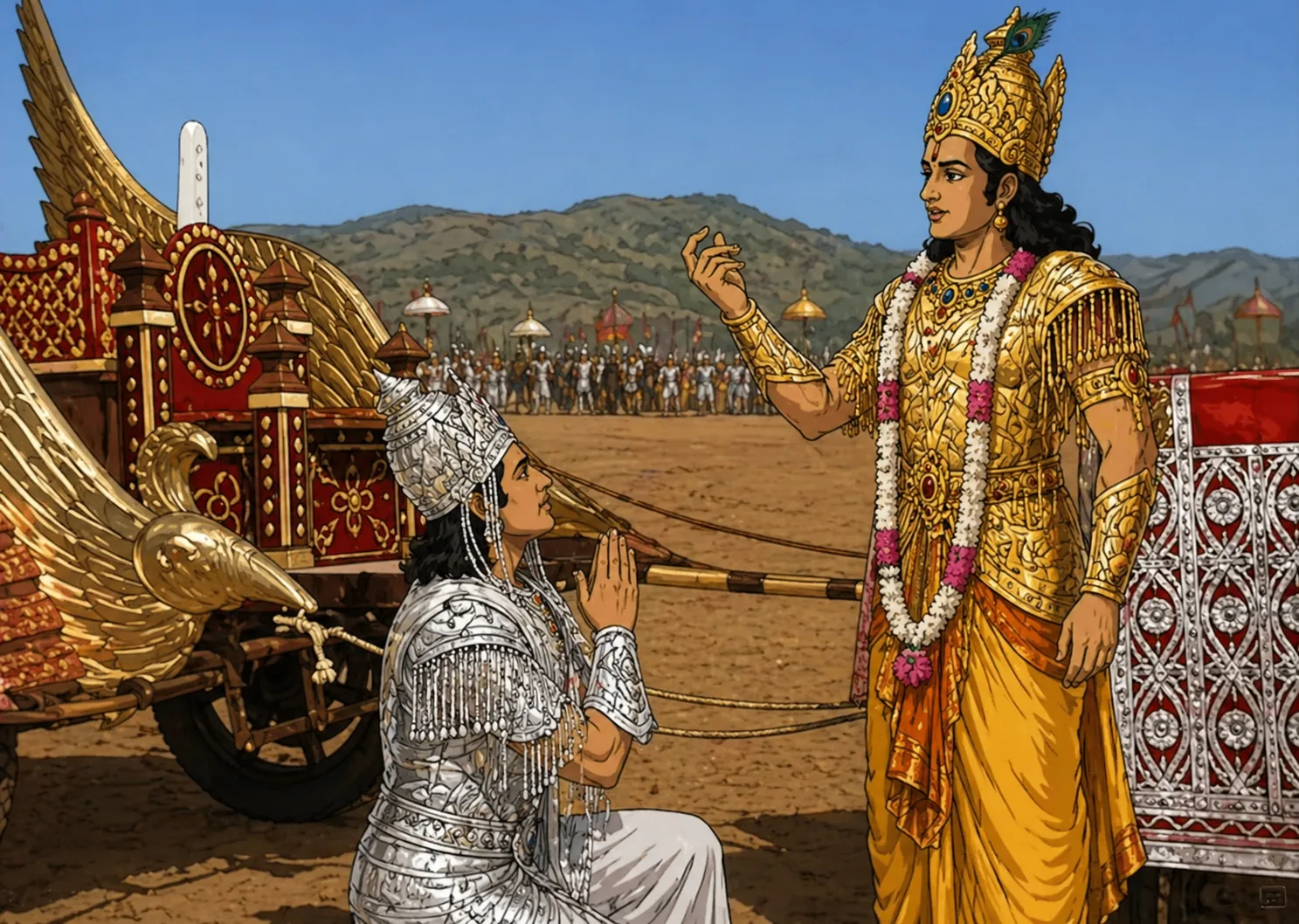
Chapter 13 is the Gita's most precise piece of metaphysical work, and in some ways its quietest. The chapter does not have a single famous verse the way Chapter 2 or Chapter 11 does. What it has is one of the most useful distinctions in any philosophical tradition: the difference between the kṣetra, the field, and the kṣetrajña, the knower of the field. The body, the mind, the emotions, the conditioned reactions: all of these are the field. The awareness that observes them, that does not change as they change, is the knower.
Once you grasp this distinction, much of the Gita's earlier teaching becomes clearer. The non-attachment of Chapter 2, the witness-self of Chapter 5, the steady mind of Chapter 6, they all rest on this one move. You learn to recognize what is observed and what does the observing, and you stop identifying with what is observed. Most modern psychology, two thousand years later, is still rediscovering this distinction under different names. The Gita places it at the centre of Chapter 13 and works through the implications carefully, verse by verse.
The Body Is the Field. You Are the One Who Knows It.
Chapter 13 begins with Arjuna asking for the cleanest definitional work of the entire book. He wants to understand the field, the knower of the field, knowledge, and what is to be known. Krishna's reply in verse 13.2 is one of the Gita's most quietly transformative sentences: idaṃ śarīraṃ kṣetram ity abhidhīyate: this body is called the field. The one who knows it is the knower of the field.
Read it slowly. The body is the field. You are not the body. You are the one who knows the body. The same distinction applies, by extension, to the mind, the thoughts, the moods, the desires. All of these are the field: they are what is observed. The knower is what does the observing. Most psychological suffering, the Gita is suggesting, comes from confusing the observer with what is being observed. You feel anxiety, and instead of noticing that you are observing anxiety, you say I am anxious, and the identification deepens the anxiety. Chapter 13 is the patient unpicking of that confusion.
एतद्यो वेत्ति तं प्राहुः क्षेत्रज्ञ इति तद्विदः ॥
idaṃ śarīraṃ kaunteya kṣetram ity abhidhīyate |
etad yo vetti taṃ prāhuḥ kṣetrajña iti tad-vidaḥ ||
"This body is called the field. The one who knows it is the knower of the field."Bhagavad Gita 13.2
Your Reactions Are Not You, They Belong to the Field
Verse 13.7 extends the field-knower distinction in a way that is psychologically devastating once you absorb it. Krishna lists what belongs to the field. Desire. Aversion. Pleasure. Pain. The body. Consciousness in its organized form. Steadiness or its lack. All of these, he says, are the field together with its modifications. They are not the knower.
Read this list and you will recognize most of what you have been calling your inner life. The wanting. The not-wanting. The agreeable sensations. The disagreeable sensations. The Gita is saying, these are all weather, not the sky. They happen in the field. You are not the field. You are the one who knows the field. The implication, lived out, is enormous. The reaction that just took over you is, on this account, observable. If it is observable, it is not, finally, you. The freedom that becomes possible from this single insight is the freedom Chapter 13 is patient enough to spell out.
एतत्क्षेत्रं समासेन सविकारमुदाहृतम् ॥
etat kṣetraṃ samāsena sa-vikāram udāhṛtam ||
Why this changes daily practice: The next time anxiety arises, try this experiment. Instead of saying "I am anxious," say "there is anxiety arising in the field." The grammar feels strange at first. After a week, the grammar starts feeling more accurate. The anxiety is still there. You are no longer fused with it. Chapter 13 is teaching exactly this defusion, two thousand years before cognitive therapy named it.
What Knowledge Actually Looks Like in a Person
Verses 13.8 through 13.12 contain the Gita's most concrete description of what knowledge looks like as a quality of character. The list is long, eighteen items in some traditional countings, and it is unexpectedly grounded. Absence of pride. Absence of pretence. Non-violence. Patience. Honesty. Service to the teacher. Cleanliness. Steadiness. Self-control. Detachment from sense objects. Absence of egoism. Recognition of birth, death, ageing, sickness as facts. Non-attachment to family. Constant equanimity. Unwavering devotion. A liking for solitude. Aversion to crowded social life. Constant awareness of the inner reality. And the seeing of the supreme reality as the goal.
Notice what the list is doing. The Gita has just made a metaphysical distinction, the field versus the knower. Now it asks: what does a person look like who has integrated this distinction? Not someone who has memorised more philosophy. Someone who has stopped needing to perform. Who has stopped reacting to provocation. Who has accepted ordinary facts like mortality without flinching. The list is the Gita's anti-portrait of egoic life, a description of what gets quieter when the field-knower confusion clears.
आचार्योपासनं शौचं स्थैर्यमात्मविनिग्रहः ॥
ācāryopāsanaṃ śaucaṃ sthairyam ātma-vinigrahaḥ ||
एतज्ज्ञानमिति प्रोक्तमज्ञानं यदतोऽन्यथा ॥
etaj jñānam iti proktam ajñānaṃ yad ato'nyathā ||
What Is Subtle Cannot Be Located, and Therefore Is Everywhere
Verse 13.16 is one of the chapter's most poetic moments, and one of its most precise. Krishna describes the supreme reality as inside and outside all beings, moving and unmoving, subtle and therefore unknowable, far away and near at hand. The phrase that catches readers is the last one. Dūra-sthaṃ ca antike ca: far away and near at hand. Both at once.
Why this paradox? Because what is everywhere cannot be located. What cannot be located is, in one sense, far, because it is not in any particular place you can point to. And in another sense, near, because there is no place it is not. The verse is not being mystical for the sake of being mystical. It is naming, precisely, the experience of trying to find the Divine. You cannot find it because it is not localised. You cannot miss it because it is not absent. The verse is, in this sense, a permanent answer to the spiritual question: where is it? Everywhere. Including, especially, in the place from which you were doing the searching.
सूक्ष्मत्वात्तदविज्ञेयं दूरस्थं चान्तिके च तत् ॥
sūkṣmatvāt tad avijñeyaṃ dūra-sthaṃ cāntike ca tat ||
Attachment to Qualities Is What Keeps Pulling You Back
Verse 13.22 explains, in one sentence, why people keep ending up in the same patterns life after life, or, if you prefer the psychological reading, year after year within the same life. The verse says: the inner being, situated in nature, experiences the qualities born of nature. Attachment to those qualities is what causes rebirth in good and bad situations.
Read in the psychological register, this is one of the most useful diagnostic verses in the book. You are caught not by what happens to you. You are caught by your attachment to the qualities (the gunas), your investment in being a certain kind of person, your craving for the kind of state you prefer, your aversion to the kind of state you don't. Drop the attachment and the qualities still appear; they just no longer have anywhere to land. Most therapy works on changing the qualities. The Gita is making a different bet: change the attachment, and the qualities lose their hold without needing to be changed first.
कारणं गुणसङ्गोऽस्य सदसद्योनिजन्मसु ॥
kāraṇaṃ guṇa-saṅgo'sya sad-asad-yoni-janmasu ||
Seeing Oneself as the Non-Doer
Verse 13.30 contains the chapter's most counter-intuitive teaching, and one of the Gita's most freeing. Krishna says: one who sees all actions as being performed by nature alone, and sees the self as the non-doer, sees rightly.
Most modern readers, conditioned by ideologies of personal agency, initially resist this verse. It can sound like a denial of responsibility. It is not. Read carefully, the verse is making a more precise claim. Actions happen. The body acts. The mind decides. The personality reacts. All of this is nature in motion. The deepest self (the knower) is the witness of all this happening. The verse is not asking you to abdicate responsibility for your actions. It is asking you to stop identifying with the doer in a way that creates suffering. You can act fully, accountably, well, and still, at the deepest level, recognize that you are not the originator of the activity in the way you imagined. That recognition is freedom.
यः पश्यति तथाऽऽत्मानमकर्तारं स पश्यति ॥
yaḥ paśyati tathātmānam akartāraṃ sa paśyati ||
"All actions are done by nature alone. The one who sees the self as the non-doer, sees rightly."Bhagavad Gita 13.30
As One Sun Lights the Whole World, The Closing Image
Chapter 13 ends with one of the most luminous images in the Gita. Krishna says: as one sun illuminates the whole world, so the knower of the field illuminates the whole field. The verse condenses the entire chapter into a single comparison. The sun is far away from what it lights, and yet what it lights is wholly seen by it. The sun is not affected by what it lights, the dust it shines on does not make the sun dusty, the cold of the morning does not make the sun cold.
The same is true of the knower. Awareness lights up the whole field, body, mind, emotions, sensations, and is not stained by any of it. The grief you feel is fully seen but does not contaminate the awareness seeing it. The joy is fully seen but does not need to be held. The image is the closing picture of the chapter and, in some ways, the closing picture of the Gita's psychology. You are the sun. The field is what your light makes visible. You are not the field. You never were.
क्षेत्रं क्षेत्री तथा कृत्स्नं प्रकाशयति भारत ॥
kṣetraṃ kṣetrī tathā kṛtsnaṃ prakāśayati bhārata ||
How Chapter 13 reframes everything earlier in the Gita: Once you have the field-knower distinction, the non-attachment of Chapter 2, the witness of Chapter 5, the steady mind of Chapter 6, the equanimity of Chapter 12: all of them rest on Chapter 13's foundation. The chapter is not as quoted as the others, but it is structurally the most important. Without it, the rest is poetry. With it, the rest becomes practice.
The Complete Verse Reference
| Verse | Speaker | Teaching Essence |
|---|---|---|
| 13.1 | Arjuna | Real knowing starts by separating the seen from the seer |
| 13.2 | Krishna | The body is observed; the knower is something else |
| 13.3 | Krishna | Knowing the field is incomplete without knowing the knower |
| 13.4 | Krishna | Clear seeing begins by separating the field from the one who knows it |
| 13.5 | Krishna | Ancient sources converge on one disciplined way of seeing |
| 13.6 | Krishna | What you call "me" is a changing system, not a single thing |
| 13.7 | Krishna | Your reactions belong to the field, not to the knower |
| 13.8 | Krishna | True strength is quiet discipline, not self-display |
| 13.9 | Krishna | Freedom begins when desire stops dressing suffering as reward |
| 13.10 | Krishna | Clinging fades; the mind stays level |
| 13.11 | Krishna | True devotion stays with one centre and loses interest in the crowd |
| 13.12 | Krishna | Knowledge is seeing reality steadily; everything else is confusion |
| 13.13 | Krishna | The highest reality frees you precisely because it outgrows every label |
| 13.14 | Krishna | What seems separate is already filled with the supreme reality |
| 13.15 | Krishna | What sustains everything is beyond the senses that perceive it |
| 13.16 | Krishna | What seems distant is already within everything |
| 13.17 | Krishna | Separation is only appearance; the many are held by one |
| 13.18 | Krishna | What illumines everything is already nearest to you |
| 13.19 | Krishna | Clear understanding becomes transformation when devotion receives it |
| 13.20 | Krishna | Change belongs to nature; awareness is not caught in it |
| 13.21 | Krishna | Action belongs to nature; experience belongs to the one who knows |
| 13.22 | Krishna | Attachment to changing qualities keeps the cycle of birth going |
| 13.23 | Krishna | Identity is borrowed from the body; the true self stands beyond it |
| 13.24 | Krishna | Clear seeing frees you while life still continues |
| 13.25 | Krishna | The same realization opens through different disciplines |
| 13.26 | Krishna | Devoted listening can carry a person beyond fear and mortality |
| 13.27 | Krishna | All forms arise from the meeting of awareness and changing nature |
| 13.28 | Krishna | Real seeing notices one imperishable presence in every changing form |
| 13.29 | Krishna | Seeing unity everywhere ends the violence that returns to yourself |
| 13.30 | Krishna | Freedom begins when you stop claiming every action as yours |
| 13.31 | Krishna | Many beings are one reality seen through different forms |
| 13.32 | Krishna | What you are remains unstained, even while life moves through you |
| 13.33 | Krishna | What is everywhere cannot be stained by what changes |
| 13.34 | Krishna | Awareness illuminates everything without being touched by what it sees |
| 13.35 | Krishna | Clear seeing separates you from what changes and opens the way beyond |
Did you like this article?