Most people approach the Bhagavad Gita as a quote book. They pick a verse, put it on a poster, and move on. That's like watching only the trailer and thinking you've seen the film. The Gita is a constructed argument — with a beginning, a buildup, a climax that breaks what you thought you knew, and an ending that lands quietly but hits harder than anything that came before it.
Here's what's remarkable: Krishna doesn't start with his biggest claim. He earns it. Over eighteen chapters, he takes a man who is intellectually sharp but emotionally collapsed and rebuilds him — not by comforting him, but by completely restructuring how he understands himself, action, death, and the nature of the universe. By the end, the man who was sitting in a chariot unable to lift his bow says: my confusion is gone, I am ready.
That transformation is not accidental. It follows a logic. And understanding that logic makes every individual verse richer.
Before Krishna Speaks a Single Word of Philosophy
The Bhagavad Gita's first verse is not spoken by Krishna. It is not spoken by Arjuna. It is spoken by a blind king, sitting far from the battlefield, asking his advisor Sanjaya for news.
Why does this matter? Because the Gita is framed as a war story, but the enemy it's actually fighting is attachment — to roles, to outcomes, to the idea that "my side" is a meaningful concept in the first place. The opening verse encodes the problem before the story has even properly begun.
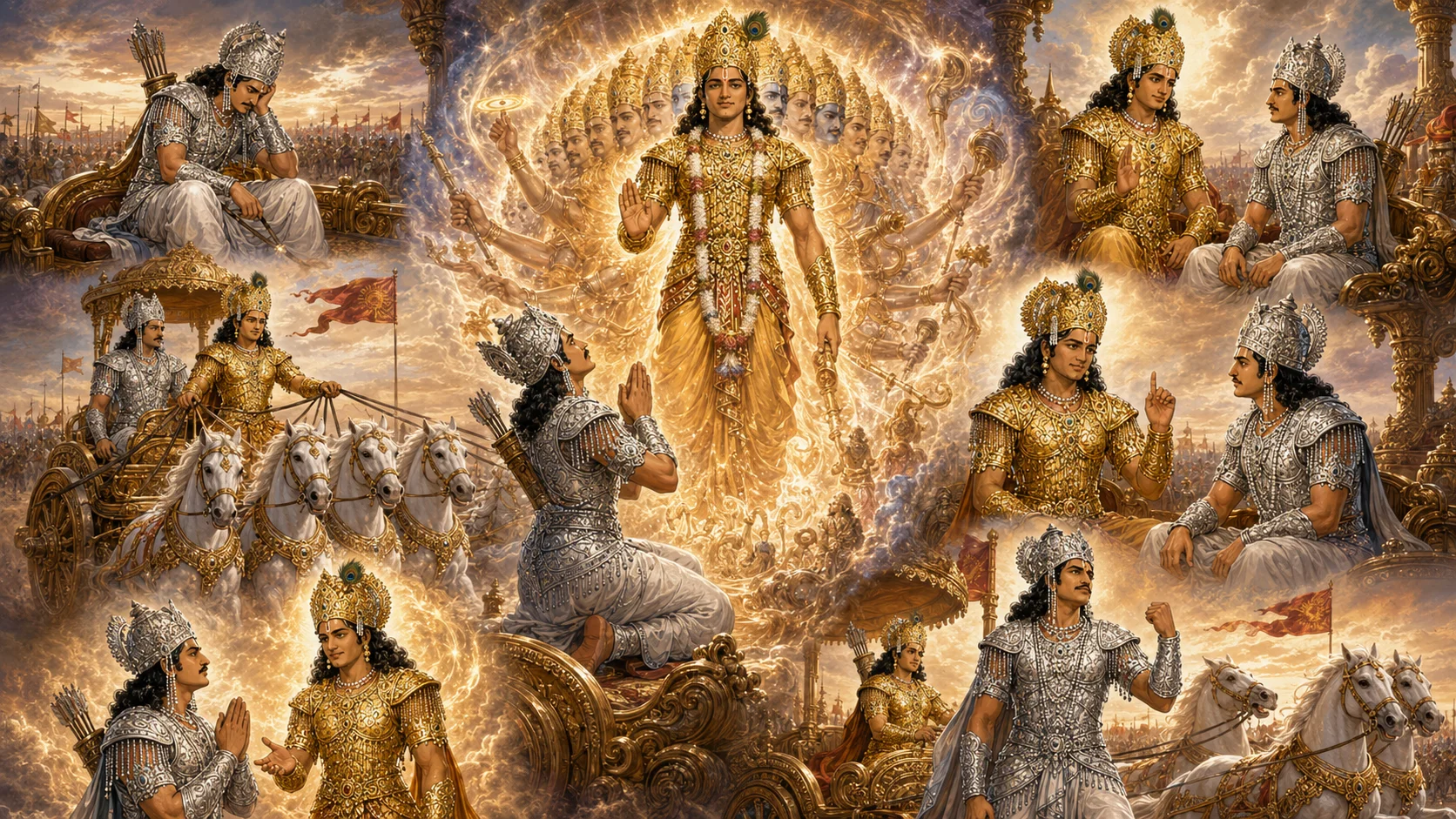
Forty-seven verses later, Chapter 1 ends with the same energy but a different person. This time it's Arjuna, the greatest warrior of his age, setting down his bow and sitting in his chariot, overwhelmed by grief.
Chapter 1 is brilliant structural writing. It makes you feel the full weight of the situation before any philosophy begins. Arjuna's grief is specific, earned, and real — he names the people he sees across the field, describes his physical symptoms in precise detail (shaking limbs, burning skin, bow slipping from his hands), and makes sophisticated ethical arguments for inaction. He's not stupid. He's not cowardly. He is genuinely caught in an impossible situation. And that matters, because what Krishna says to him over the next 17 chapters has to be worthy of the real seriousness of his crisis.
Act I: Build the Foundation Before You Build the House
Krishna's opening move is not what you'd expect. Arjuna has given him an ethical and emotional crisis. Krishna's first substantive response is metaphysics. He doesn't say "I understand your pain." He says: you're grieving for things that don't deserve grief, and calling it wisdom.
Why start with the soul? Because every practical teaching that follows — about action, duty, attachment, peace — rests on this foundation. If the self that you're protecting when you grieve is actually eternal and indestructible, then the nature of "loss" is different. If the soul cannot be killed, then certain arguments about the moral horror of battle need to be re-examined.
With the metaphysical foundation in place, Krishna moves to the practical. Chapter 2 gives us 2.47 — the verse that has probably been quoted more than any other in the Gita. And the reason it lands so hard is exactly because it comes after the soul teaching. Once you understand that you are not the outcome, you can act differently.
Chapters 3, 4, and 5 extend and ground this teaching. Chapter 3 says: you cannot not act — even the decision to sit still is an action. Chapter 4 drops a quiet bombshell (Krishna begins to hint at his own divine nature — more on that shortly). Chapter 5 resolves the apparent contradiction between renunciation and action: the lotus leaf lives in water but remains dry. You can be fully in the world, doing everything required, without being soaked by it.
Chapter 6 is the hinge. It covers meditation — dhyana yoga — and contains one of the most humanly honest exchanges in the entire Gita. Arjuna listens to all of Krishna's teaching on meditation and mind control, and then says, essentially: this is impossible. The mind is like wind. How can anyone control it?
"The mind is restless, turbulent, powerful, obstinate — controlling it seems as difficult as controlling the wind."Arjuna — Bhagavad Gita 6.34
Krishna's answer in 6.35 is not "you're wrong, it's easy." It is: yes, the mind is hard to control. But with practice (abhyāsa) and detachment (vairāgya), it can be done. The fact that it's hard doesn't mean it's impossible. And the fact that Arjuna is asking the question means he already knows it matters.
Act I — six chapters, the philosophical foundation of the Gita — ends here. Arjuna has a theory of the self, a theory of action, a theory of renunciation, and the beginning of a meditation practice. He is better equipped than when he started. But Krishna is not done. Not even close.
Act II: The Screenplay Changes Register
Act I was philosophy. Practical, rigorous, applicable. Act II is something else entirely.
In Chapter 7, Krishna starts to reveal who he actually is. Not as a philosophical proposition, but as a direct statement: everything is strung on me, like pearls on a thread. This is not a metaphor for some abstract divine principle. Krishna is saying: I am the thread. Everything you see exists within me.
Chapter 8 introduces the idea that what you hold in your mind at death matters — that the quality of consciousness at the moment of departure shapes what follows. Chapter 9 offers what Krishna calls the "royal secret" — the most intimate revelation yet: I am in all things and all things are in me. And I accept whatever is offered with genuine love, even a leaf, a flower, a drop of water.
Chapter 10 is Krishna's catalogue of his own divine manifestations. He is the Ganga among rivers, the Himalaya among mountains, the lion among animals, the thunderbolt among weapons, the letter A among alphabets, the spring among seasons. The teaching is that whenever you encounter something of surpassing beauty, power, or excellence, you are glimpsing a fragment of the divine. This is not philosophy — it is a way of training the eyes to see.
The narrative logic of Chapters 7–10: Krishna is building up to something. He spends four chapters systematically establishing his divine nature — making cosmic claim after cosmic claim, each larger than the last. He is not doing this to be impressive. He is preparing Arjuna for what he is about to be asked to see. When Chapter 11 arrives, the buildup has earned what it's about to show.
Chapter 11 — The Scene That Breaks Everything
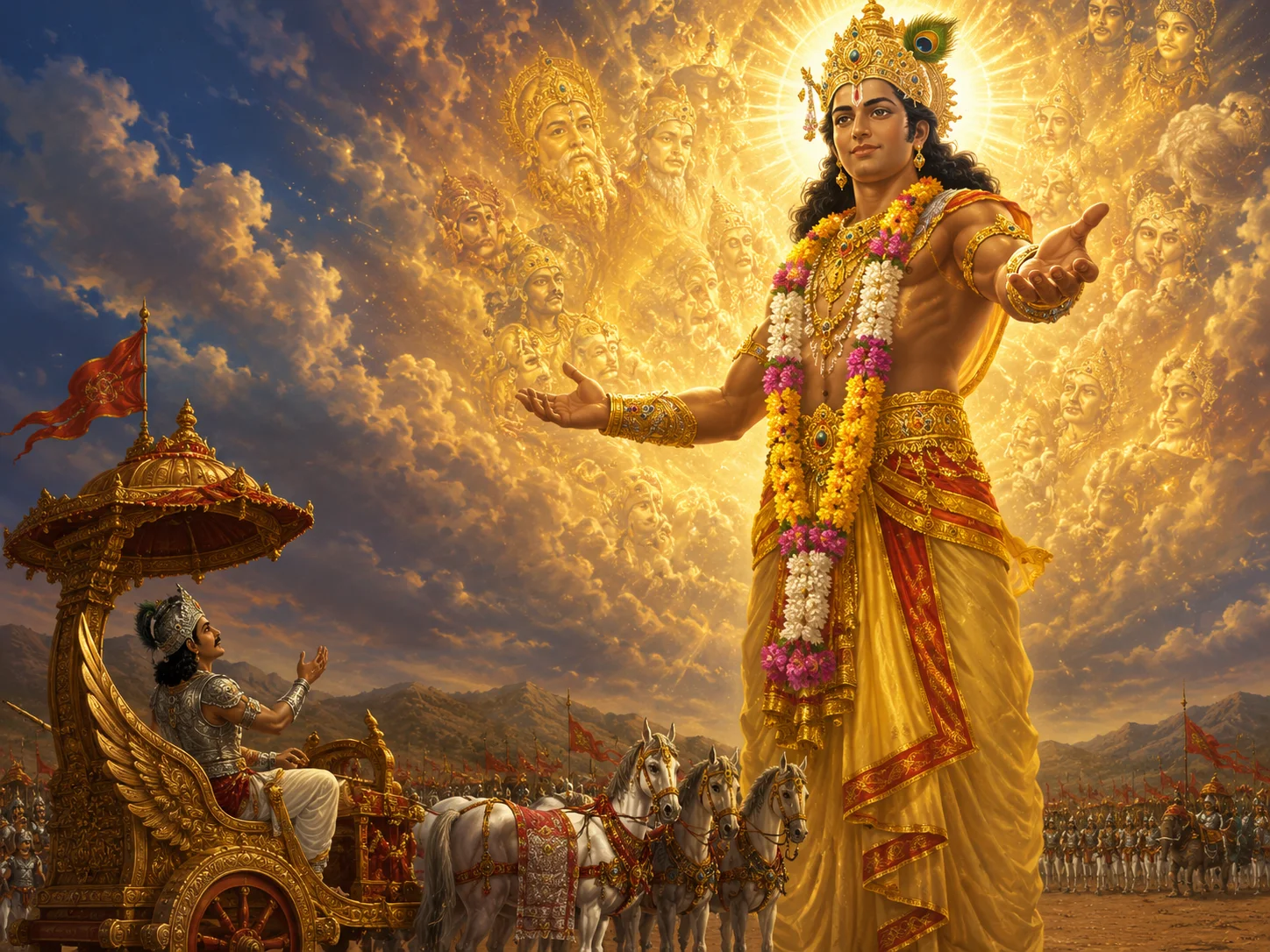
Arjuna asks to see it. After four chapters of Krishna describing his divine nature in words, Arjuna says: show me. If you are everything you say you are, show me your universal form.
Krishna gives him divine sight. And what Arjuna sees is the entire cosmos — every god, every being, every world, past and future — contained within one form. He sees the warriors arrayed on both sides of the battle already consumed, already dead. He sees time itself in the shape of his charioteer.
And then comes the verse that stops everything. Krishna speaks, within the cosmic form, and says:
Arjuna is terrified. He begs Krishna to return to his human form. He says: the world was more beautiful when I could see your face. This is not weakness — it is the honest response to genuine overwhelm. No human being can hold the cosmic vision for long. And Krishna, with characteristic grace, returns to his familiar form and teaches Arjuna Chapter 12: after you have seen what I am, the appropriate response is devotion. Not terror. Not philosophical analysis. Just love.
Act III: The Film Doesn't End at the Climax
Here is one of the Gita's most surprising structural choices: the cosmic vision happens in Chapter 11. There are seven more chapters after it. Most stories would end here. The hero has seen the truth; the lesson is delivered. But the Gita has more work to do.
Chapters 13 through 18 are the Gita's systematic philosophy — dense, rigorous, building on everything that came before. They are sometimes called the Gita's most difficult section. They are also, in many ways, its most complete.
Chapter 13 introduces the distinction between the field (kshetra — the body, the material) and the knower of the field (kshetrajna — the soul, the conscious witness). This is the Gita's clearest map of identity: you are not your body, not your mind, not your circumstances. You are the one who knows them.
Chapter 14 introduces the three gunas — sattva (clarity, harmony), rajas (activity, passion), and tamas (inertia, heaviness). These are the three qualities of material nature that shape every human experience. Understanding them is a diagnostic tool: when you are restless, rajas is dominant. When you are clear and calm, sattva is active. When you cannot motivate yourself, tamas has taken hold. The guna framework is one of the Gita's most practically useful contributions.
Chapter 15 offers one of the Gita's most striking images — the eternal ashvattha tree, with its roots above and branches below. The manifest world is this inverted tree. To understand it, you have to see where the roots actually are — in the eternal, not the temporal.
Chapters 16 and 17 classify human qualities into divine and demonic, and distinguish three kinds of faith. They are a mirror: recognise which qualities operate in you, and you know what work remains.
And then Chapter 18. The grand finale.
The Verse That Reframes Everything That Came Before
Chapter 18 is the Gita's longest chapter — 78 verses — and its most complete. It synthesises karma yoga, jnana yoga, bhakti yoga. It revisits renunciation. It discusses the three gunas in action. It offers a final taxonomy of knowledge, action, reason, and determination.
And then, near the end, Krishna says something unexpected.
After 17 chapters of philosophy, yoga, meditation, cosmic revelation, and systematic metaphysics — after offering Arjuna every possible framework for understanding his situation — Krishna offers a different kind of teaching. Not a framework. Not a path. A relationship.
Think about the structural weight of this. Chapter 2 gives us 2.47 — do your duty without attachment to results. A teaching about action and detachment. It asks a lot of the practitioner. It requires discipline, awareness, a kind of active renunciation in the middle of doing. Chapter 18 gives us 18.66 — surrender completely. Not even dharma as a basis. Just: come to me.
The Gita begins by teaching Arjuna to act without depending on outcomes. It ends by inviting him to stop depending on anything at all — except the one he's been talking to for 17 chapters. The progression is: independence from outcomes → independence from frameworks → complete dependence on the divine. The spiritual journey in the Gita goes not from dependence to independence, but from small dependence (on outcomes, on results, on role) to the only dependence that doesn't create bondage.
Krishna then says something even more striking, two verses before: "You are dear to me."
And then — the final voice in the Gita belongs not to Krishna but to Arjuna. The discourse is over. The choice is his. Krishna has done his work. What does Arjuna say?
Five Things Krishna Does Across All 18 Chapters
- He earns every claim. Krishna doesn't announce his biggest ideas first. He builds a foundation, then a floor, then a wall. The claim "I am time, the destroyer of worlds" lands in Chapter 11 with devastating force precisely because six chapters of philosophy have already been established. The Vishwarupa is not a revelation without context — it is the culmination of an argument.
- He answers the question behind the question. Arjuna asks: should I fight? Krishna answers: you don't understand what death is, what the self is, or what action is — so the question you're asking is malformed. He rebuilds the questioner before he answers the question.
- He alternates between grandeur and intimacy. The Gita moves rhythmically between cosmic claims and personal warmth. After the terror of the Vishwarupa, the softness of 9.26 (I accept even a leaf). After the systematic philosophy of Chapters 13–17, the tenderness of 18.65 (you are dear to me). The oscillation is intentional — it keeps the teaching from becoming either coldly abstract or sentimentally narrow.
- He never removes Arjuna's choice. At the end of the entire discourse, Krishna explicitly says (18.63): "I have told you the most secret wisdom. Now reflect on it fully, and do as you wish." After 700 verses, the autonomy is returned. The Gita is not a command. It is an invitation to clarity — and clarity still requires a choice.
- The ending is quieter than the climax. Chapter 11 is the Gita's most spectacular moment. But 18.66 — whispered, intimate, radical — is its most important. The Gita builds to thunder and ends in stillness. That is a structural choice, and it is perfect.
Let it stay with you all day.
The Wisdom app delivers one Bhagavad Gita verse each day — Devanagari script, transliteration, meaning, and how it applies right now. 700 verses. Home screen widget. Free.