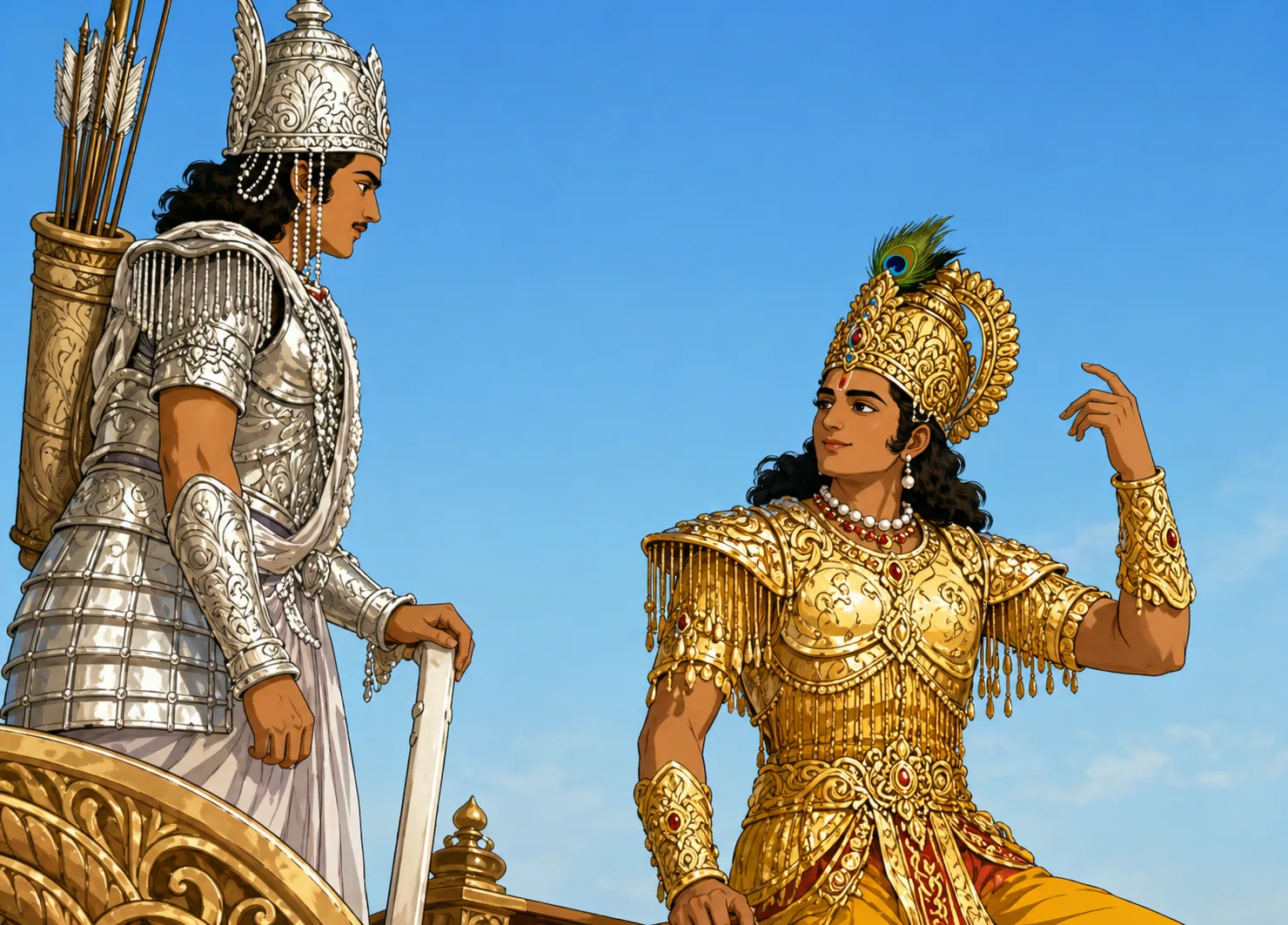
By the time we reach Chapter 5, the question has been asked in every way possible: should I act, or should I renounce? Krishna has answered it in different registers, philosophically, practically, metaphysically. Chapter 5 gives the final direct answer. Both paths work. But karma yoga, the yoga of selfless action, is the better one for most people. And then it goes deeper, into what it looks like to be truly free from within, while still fully in the middle of things. This is perhaps the most practical chapter in the Gita, because it speaks directly to the confusion of anyone trying to live wisely while still living in the world.
Chapter 5 is also the shortest complete teaching unit in the Gita, just 29 verses. But those 29 verses contain some of the tradition's most potent metaphors. The lotus leaf. The equal vision that sees the learned and the outcast as expressions of the same consciousness. And the final verse, so quiet in its power, that reframes everything: when you know the Divine as the friend of all beings, peace arrives not as an achievement but as recognition.
Both Paths Lead Home, But One Is Shorter
Chapter 5 opens with Krishna settling the debate that has animated the last four chapters. By now, Arjuna has heard that he should act without attachment, perform his duty, offer everything to the Divine, and understand the nature of the self. He has also heard teachings that sound like renunciation. So which is it? The answer comes clearly.
तयोस्तु कर्मसंन्यासात्कर्मयोगो विशिष्यते ॥
tayostu karmasaṃnyāsātkarmayogo viśiṣyate ||
निर्द्वन्द्वो हि महाबाहो सुखं बन्धात्प्रमुच्यते ॥
nirdvandvo hi mahābāho sukhaṃ bandhātpramucyate ||
This is the Gita's final word on the renunciation question, and it is liberating. You don't need to abandon the world. You need to abandon your desperate grip on it. A householder who acts with detachment is more renounced than an ascetic who secretly wants spiritual prestige. The distinction isn't external. It's the quality of your internal freedom.
The Lotus Leaf Metaphor: Being in Water Without Getting Wet
Chapter 5 contains one of the tradition's most beautiful and psychologically precise metaphors. The lotus leaf lives in water, draws nourishment from it, and is never wet. The image speaks to the deepest human desire: how to participate fully in life without being contaminated by it.
लिप्यते न स पापेन पद्मपत्रमिवाम्भसा ॥
lipyate na sa pāpena padmapatramivāmbhasā ||
"Like a lotus leaf untouched by water, the wise one acts fully engaged but never contaminated."Bhagavad Gita 5.10
This verse is central to understanding how the Wisdom app works in practice. You're not being asked to withdraw. You're being asked to act with clarity about what you can and cannot control. You do the work. You show up. You engage fully. But you recognize that the outcome belongs to forces larger than your personal effort. That recognition, that surrender, is the lotus leaf's dry surface.
The Radical Teaching of Equal Sight
In the middle of Chapter 5 comes one of the Gita's most socially radical verses. It challenges not just spiritual understanding but the fundamental way most people organize their regard for others.
शुनि चैव श्वपाके च पण्डिताः समदर्शिनः ॥
śuni caiva śvapāke ca paṇḍitāḥ samadarśinaḥ ||
A note on social consciousness: The Gita's teaching on equal vision is one of the most important contributions to ethical thought across traditions. It doesn't deny social difference. It refuses to let social difference determine spiritual worth. The divine presence isn't higher in a brahmin and lower in a dog-eater. It's equally present. The wise person sees this.
The Source of Peace Is Internal
Chapter 5 contains repeated teachings on one point: your real happiness is not in your circumstances. It is inside you. This isn't denial of external life. It's clarity about where your stability comes from.
स योगी ब्रह्मनिर्वाणं ब्रह्मभूतोऽधिगच्छति ॥
sa yogī brahmanirvāṇaṃ brahmabhūto'dhigacchati ||
The Quiet Recognition That Ends in Peace
Chapter 5 does something remarkable. It doesn't end with a technique. It doesn't end with a discipline or a practice. It ends with a single fact: when you know the Divine as the friend of all beings, peace arrives. Not as a reward. As a natural consequence.
सुहृदं सर्वभूतानां ज्ञात्वा मां शान्तिमृच्छति ॥
suhṛdaṃ sarvabhūtānāṃ jñātvā māṃ śāntimṛcchati ||
This is how Chapter 5 ends. Not with a command. With a promise. When you understand that you are held, that your efforts matter, that your suffering has meaning, that you belong to something larger than your fear, peace becomes inevitable. It's not something you achieve. It's something you recognize. The Wisdom app brings this teaching to you daily because it's the teaching that sustains practice when practice feels difficult. You're not earning salvation. You're remembering that you were never lost.
The Complete Verse Reference
| Verse | Speaker | Teaching Essence |
|---|---|---|
| 5.1 | Arjuna | Confusion before clarity, asking the right question |
| 5.2 | Krishna | Selfless action is greater than mere withdrawal |
| 5.3 | Krishna | Freedom is found by rising above desire and aversion |
| 5.4 | Krishna | Different sincere paths all lead to the same truth |
| 5.5 | Krishna | Different paths, walked sincerely, arrive at the same goal |
| 5.6 | Krishna | Engaging in duties with the right spirit brings peace, no need to run |
| 5.7 | Krishna | Self-mastery and pure intentions free us from the burden of our actions |
| 5.8 | Krishna | Your true self is a witness, not the sum of your actions |
| 5.9 | Krishna | You are the witnessing Self, not the doer caught in activity |
| 5.10 | Krishna | Act with surrender; let go of attachment, nothing negative can touch you |
| 5.11 | Krishna | Act selflessly, let go of results, focus on purity of intent |
| 5.12 | Krishna | Detach from results, find peace in the work itself |
| 5.13 | Krishna | True happiness arises when senses are mastered and action is surrendered |
| 5.14 | Krishna | You are not the sole doer, life naturally unfolds through you |
| 5.15 | Krishna | Ignorance hides the truth; liberation comes from uncovering it |
| 5.16 | Krishna | True knowledge lights up your life and uncovers the divine within |
| 5.17 | Krishna | True focus anchored in wisdom leads to freedom from rebirth |
| 5.18 | Krishna | See the Divine in everyone, regardless of outer differences |
| 5.19 | Krishna | True victory is inner steadiness, equanimity connects you with the Divine |
| 5.20 | Krishna | True wisdom is remaining steady no matter what life brings |
| 5.21 | Krishna | True happiness is inner, not an external achievement |
| 5.22 | Krishna | Short-term pleasures lead to long-term unhappiness, seek what lasts |
| 5.23 | Krishna | Mastering desires and anger leads to true happiness |
| 5.24 | Krishna | Your truest peace and joy are always inside you, not outside |
| 5.25 | Krishna | Peace and liberation blossom when you master yourself and live for others |
| 5.26 | Krishna | Lasting peace is found by mastering desire, anger, and the mind |
| 5.27 | Krishna | True liberation begins with mastery over mind, senses, and breath |
| 5.28 | Krishna | Self-mastery and absence of desire, fear, and anger are keys to freedom |
| 5.29 | Krishna | Knowing the Divine as the friend of all beings leads to true peace |
Did you like this article?