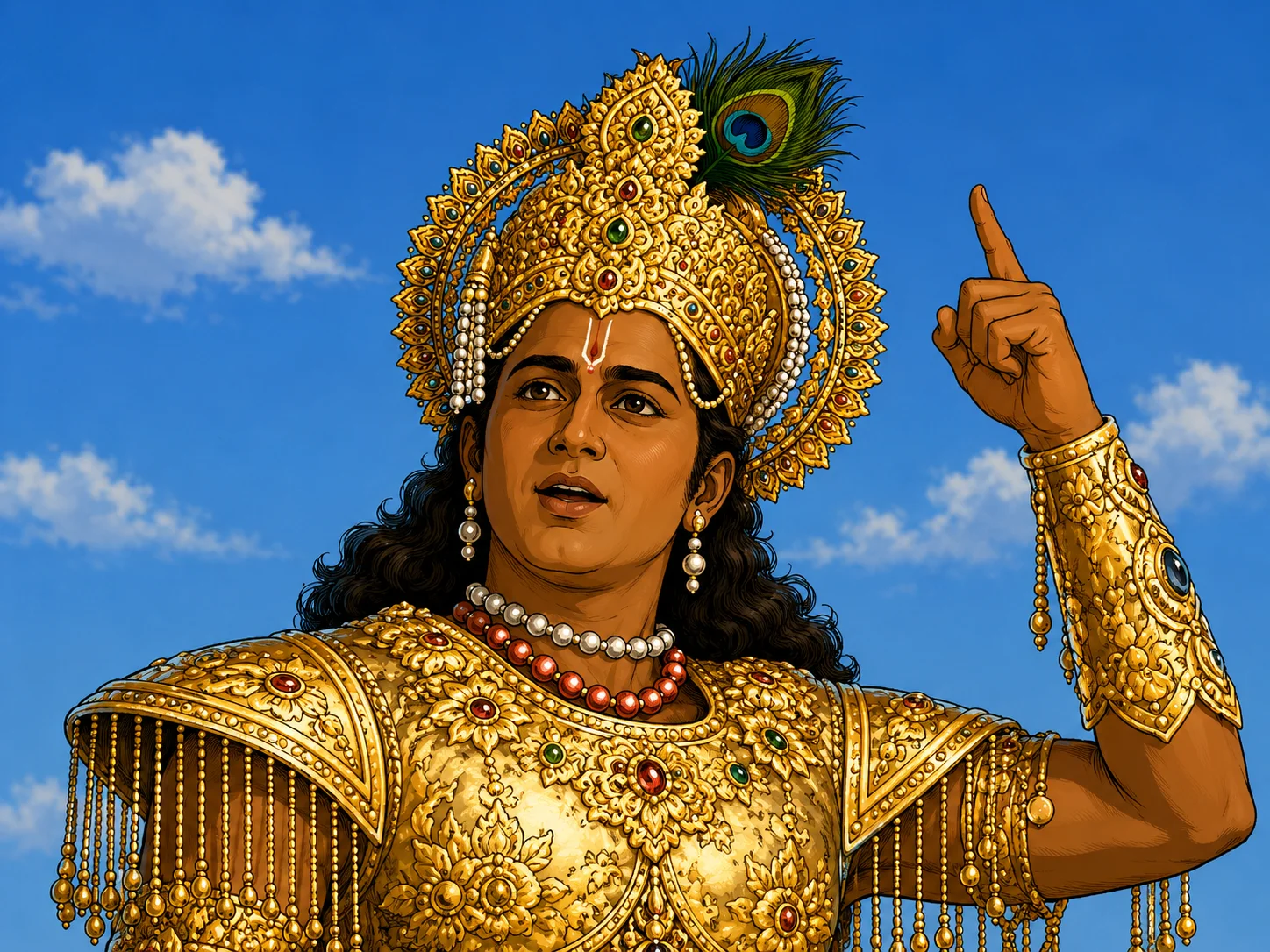
Bhagavad Gita · Adhyay 10 · 42 Verses

Bhagavad Gita Chapter 10 (Adhyay 10) —
Vibhuti Yoga

Where to look for God: in everything that shines. The lamp of knowledge inside the heart. The Self at the beginning, middle, and end. And the single fragment that holds the whole universe.

Sparks of divine radiance scattered across the manifest world — Chapter 10 of the Bhagavad Gita, Vibhuti Yoga, teaches that every form of greatness in creation is a fragment of one source.

Chapter 10 is a chapter about where to look. After Chapter 9 establishes that the Divine holds everything, Chapter 10 turns the next, more practical question — if the Divine is in everything, how do I begin to see it? Krishna's answer is unexpectedly concrete. He gives Arjuna a long list of specifics. Look at the sun. Look at the moon. Look at consciousness inside living beings. Look at the silence among secrets. Look at greatness wherever you find it — in art, in courage, in beauty, in restraint — and recognise it as a spark of one radiance.

This is the chapter most often misread as a mere catalogue. It is not. The list is a training in attention. Most people, most of the time, look at the world and see only itself — a sun, a person, a kind word. Chapter 10 is asking you to look again and notice the second layer. Behind every form of brilliance, the Gita says, is the same source. Once you start seeing this pattern, you cannot easily unsee it. The chapter is not asking you to believe anything. It is asking you to look, with a slightly different question in mind.

Verses 10.7–10.8 · The Source

Where Everything Comes From

Chapter 10 opens by establishing what the rest of the chapter will illustrate. Verse 10.8 is the structural claim: I am the source of all; from me, everything proceeds. Knowing this, the wise worship me with wholehearted feeling. The verse is doing two things at once. Metaphysically, it locates the origin of everything in a single point. Practically, it explains why the wise person responds to that knowledge with devotion. When you really know where everything comes from, the response is not analysis. It is reverence.

Notice the chain. First the recognition (iti matvā — knowing this). Then the response (bhajante — they worship). Then the quality of the response (bhāva-samanvitāḥ — full of feeling). The Gita is not asking for an intellectual concession. It is describing what understanding actually feels like when it lands. The mind sees the source. The heart turns toward it. The two are not separate moves.

Bhagavad Gita 10.8Speaker: Krishna
अहं सर्वस्य प्रभवो मत्तः सर्वं प्रवर्तते ।
इति मत्वा भजन्ते मां बुधा भावसमन्विताः ॥
ahaṃ sarvasya prabhavo mattaḥ sarvaṃ pravartate |
iti matvā bhajante māṃ budhā bhāva-samanvitāḥ ||
Meaning
I am the source of all; from me everything proceeds. Knowing this, the wise worship me with wholehearted feeling.
Knowing the source changes the response
Information alone does not produce devotion. But information about a source — once it actually lands — changes the relationship to everything downstream. The verse is describing what happens after the abstraction stops being an abstraction. The wise are not wise because they know more. They are wise because the knowing has become love.
"Knowing the source turns understanding into devotion."
Verses 10.10–10.11 · The Lamp Inside

The Lamp of Knowledge Lit From Within

Verses 10.10 and 10.11 are a pair, and together they describe what happens to a person whose devotion has become continuous. Krishna says: to those who are always united with me, who worship with love, I give the buddhi-yoga — the yoga of discernment — by which they come to me. And then he goes further: out of compassion for them, I destroy the darkness born of ignorance, dwelling in their own being, with the shining lamp of knowledge.

Look closely at where the lamp is. It is ātma-bhāva-stho — placed in their own being. The Divine is not lighting the lamp from outside, illuminating them. The Divine is lighting a lamp from inside them. The image is intimate. The conditions for the lamp's lighting are simple — continuous devotion, love — and the result is the most reassuring promise in the Gita: the darkness in you is not yours alone to fight. It is dispelled by a light that has been placed inside you.

Bhagavad Gita 10.10Speaker: Krishna
तेषां सततयुक्तानां भजतां प्रीतिपूर्वकम् ।
ददामि बुद्धियोगं तं येन मामुपयान्ति ते ॥
teṣāṃ satata-yuktānāṃ bhajatāṃ prīti-pūrvakam |
dadāmi buddhi-yogaṃ taṃ yena mām upayānti te ||
Meaning
To those who are constantly united with me, who worship me with love, I give the yoga of discernment by which they come to me.
What buddhi-yoga is
Buddhi-yoga is not technique. It is the gift of clearer seeing — the ability to discriminate, in real time, between what is real and what only seems real. The Gita's promise is that this is not earned by effort alone. It is given. The condition is not cleverness. It is continuous orientation toward the Divine in love.
"Steady devotion itself draws forth the understanding that reaches the divine."
Bhagavad Gita 10.11Speaker: Krishna
तेषामेवानुकम्पार्थमहमज्ञानजं तमः ।
नाशयाम्यात्मभावस्थो ज्ञानदीपेन भास्वता ॥
teṣām evānukampārtham aham ajñāna-jaṃ tamaḥ |
nāśayāmy ātma-bhāva-stho jñāna-dīpena bhāsvatā ||
Meaning
Out of compassion for them, dwelling in their own being, I destroy the darkness born of ignorance with the shining lamp of knowledge.
The lamp is on your side of the wall
The verse places the lamp inside the devotee — ātma-bhāva-stho. This matters. The Divine is not a remote light source you are trying to reach. The light is lit inside you. Your work is not to generate it. Your work is to keep the room ordered enough that the lamp's light is not blocked by your own clutter.
"Compassion becomes knowledge that burns away inner darkness."
"Out of compassion, dwelling in your own being, I destroy the darkness with the shining lamp of knowledge."
Bhagavad Gita 10.11
Verse 10.20 · The Self in the Heart

I Am the Self Seated in the Heart of All Beings

Verse 10.20 is the moment in Chapter 10 where the long list of manifestations gets a personal centre. Krishna says: I am the Self, Arjuna, seated in the heart of all beings. I am the beginning, the middle, and the end of all beings. After many verses about external splendour — among radiant beings I am Indra, among rivers I am the Ganga — the verse turns inward. The most important manifestation is not outside. It is in the heart of every being you will ever meet.

This is the verse that the rest of the chapter's list exists to support. If you only read the external list, the Gita can sound like a celebration of greatness. Read with 10.20 at the centre, the chapter reverses direction. Yes, the Divine is in the brilliant. The Divine is also in the heart of the unremarkable person sitting next to you on the train. The two manifestations are the same manifestation, in different clothing. The chapter is teaching you to see both with the same recognition.

Bhagavad Gita 10.20Speaker: Krishna
अहमात्मा गुडाकेश सर्वभूताशयस्थितः ।
अहमादिश्च मध्यं च भूतानामन्त एव च ॥
aham ātmā guḍākeśa sarva-bhūtāśaya-sthitaḥ |
aham ādiś ca madhyaṃ ca bhūtānām anta eva ca ||
Meaning
I am the Self, Arjuna, seated in the heart of all beings. I am the beginning, the middle, and the end of all beings.
The centre verse of the chapter
Every other manifestation in Chapter 10 is, in some sense, a footnote to this one. If the Self is in every heart, then everything else — the sun, the moon, the sacred sound — is a consequence, not the centre. The verse asks you to look at the next person you meet with a different awareness: you are looking at the dwelling place of what you have been searching for.
"Everything that exists is held within one enduring presence."
Verses 10.21–10.37 · The Long List

How to Read the Long Catalogue of Manifestations

Beginning at verse 10.21 and continuing for about fifteen verses, Krishna gives Arjuna a long catalogue. Among the suns, I am Vishnu. Among the rivers, the Ganga. Among the months, Margashirsha. Among letters, the letter A. Modern readers sometimes find this section tedious — a list of mostly culturally specific examples. That is to misread the section's purpose. The catalogue is not asking you to memorise it. It is training you in a way of seeing.

Notice the structure of every entry. Krishna names a category — the senses, the seasons, the rivers — and within that category, he names what is supreme. The lesson is portable. Whenever you encounter a category, look for its highest expression, and recognise that expression as the Divine. The list teaches a habit: look at the best of something, see the spark, repeat. After enough repetitions, you start seeing it everywhere. The chapter is, in this sense, a perception training disguised as a hymn.

Bhagavad Gita 10.22Speaker: Krishna
वेदानां सामवेदोऽस्मि देवानामस्मि वासवः ।
इन्द्रियाणां मनश्चास्मि भूतानामस्मि चेतना ॥
vedānāṃ sāma-vedo'smi devānām asmi vāsavaḥ |
indriyāṇāṃ manaś cāsmi bhūtānām asmi cetanā ||
Meaning
Among the Vedas I am the Sama Veda; among the radiant beings I am Indra. Among the senses I am the mind; among living beings I am consciousness.
Read for the pattern, not the items
The items are culturally bound. The pattern is universal. Whatever a category's exemplar is — for you, in your time, your place — that is where the Divine is most visibly shining. Read the verse with this question: in my world, what is the equivalent? Not as escape from the verse, but as enactment of it.
"The divine is not elsewhere; it is the awareness within everything."

How to actually use Chapter 10's catalogue: Pick any category in your life — books, music, kinds of conversations, types of meals, kinds of weather. Identify, honestly, what its supreme example is, for you. Then sit with the recognition that what you are admiring is a spark. The admiration was already half-spiritual. The chapter is just asking you to notice the second half.

Verse 10.38 · The Quietest Power

Silence Among Secrets, Restraint Among Powers

Verse 10.38 is one of the chapter's surprising moments. Krishna says: among enforcers, I am the rod of punishment; among those seeking victory, I am wise policy; among secrets, I am silence; among the wise, I am knowledge. The first two are conventional. The third is the verse's quiet bombshell. The deepest secret is not a hidden word. It is silence itself.

This contradicts most assumptions about spiritual depth. We tend to imagine the highest teaching as a sentence that, once spoken, would unlock everything. The Gita says the opposite. The highest teaching has already been spoken. What is hidden — what is most worth protecting — is the silence underneath the words. Real power, the verse adds, is not volume. It is restraint and timing — knowing what to say, when, and what to leave unsaid. The most important spiritual capacity, by this reading, is the capacity to be quiet when speaking would be easier.

Bhagavad Gita 10.38Speaker: Krishna
दण्डो दमयतामस्मि नीतिरस्मि जिगीषताम् ।
मौनं चैवास्मि गुह्यानां ज्ञानं ज्ञानवतामहम् ॥
daṇḍo damayatām asmi nītir asmi jigīṣatām |
maunaṃ caivāsmi guhyānāṃ jñānaṃ jñānavatām aham ||
Meaning
Among enforcers, I am the rod of punishment; among those seeking victory, I am wise policy; among secrets, I am silence; among the wise, I am knowledge.
The deepest secret is silence
The Sanskrit is maunaṃ caivāsmi guhyānāṃ — among secrets I am silence. The line subverts every model of esoteric teaching. The hidden knowledge is not a hidden sentence. It is the silence that the sentence is trying to gesture at. When the silence is reached, the sentence is no longer needed. The Gita is, in this verse, quietly retiring its own authority.
"True power is measured by restraint, silence, and clear understanding."
"Among secrets, I am silence. Among the wise, I am knowledge."
Bhagavad Gita 10.38
Verses 10.41–10.42 · The Closing Reveal

Every Form of Brilliance Is a Spark

Chapter 10 closes with two of its most important verses. Verse 10.41 says: whatever being or thing is endowed with splendour, beauty, or power — know that to have arisen from a spark of my radiance. The verse retrofits everything that came before. Now you understand why Krishna spent so long enumerating examples of greatness. He was showing you, again and again, what a spark looks like.

Then comes verse 10.42, the chapter's final word: or, Arjuna, what need is there to know all this in such detail? I sustain this entire universe with a single fragment of myself. The Gita ends the catalogue by admitting that the catalogue is, in the end, unnecessary. You did not need every example. The point of every example was the same. The Divine is in the brilliant, in the ordinary, in the supreme, in the small, and after all of it — the Divine has not been exhausted. A single fragment holds the universe. Everything you have seen is a smaller fragment of that fragment.

Bhagavad Gita 10.41Speaker: Krishna
यद्यद्विभूतिमत्सत्त्वं श्रीमदूर्जितमेव वा ।
तत्तदेवावगच्छ त्वं मम तेजोंऽशसंभवम् ॥
yad yad vibhūtimat sattvaṃ śrīmad ūrjitam eva vā |
tat tad evāvagaccha tvaṃ mama tejo'ṃśa-sambhavam ||
Meaning
Whatever being or thing has splendour, beauty, or power — know it to be born from a spark of my radiance.
The portable version of Chapter 10
If you only remember one verse from this chapter, make it this one. The verse is a rule: anywhere you see brilliance, the brilliance is borrowed. Trace the brilliance back, and you reach the source. After enough tracing, the source is no longer distant. You start to recognise it everywhere — in art, in courage, in love, in a clear sky, in a kind sentence said at the right time.
"Every genuine greatness is only a spark of my radiance."
Bhagavad Gita 10.42Speaker: Krishna
अथवा बहुनैतेन किं ज्ञातेन तवार्जुन ।
विष्टभ्याहमिदं कृत्स्नमेकांशेन स्थितो जगत् ॥
athavā bahunaitena kiṃ jñātena tavārjuna |
viṣṭabhyāham idaṃ kṛtsnam ekāṃśena sthito jagat ||
Meaning
Or, Arjuna, what need is there to know all this in such detail? I support this entire universe with a single fragment of myself.
The line that retires the catalogue
Ekāṃśena — with one fragment. The entire universe — every spark Krishna has just enumerated — is sustained by a single fragment of the Divine. The catalogue was not exhaustive. It could not be. The point of the catalogue was the recognition, and the recognition leads to a still bigger fact: whatever you have seen, the unseen is incalculably greater. The chapter ends in awe, not in inventory.
"The whole universe rests in a single fragment of the divine."

Why this is the chapter's emotional ending: Chapter 10 starts as a list and ends as a reduction. After all the looking, the point is not that you have seen many things. The point is that what you have seen is a fragment of a fragment. The right response to that fact is not more cataloguing. It is the awe that produces, naturally, the vision Arjuna asks for in the very next chapter.

All 42 Verses At a Glance

The Complete Verse Reference

VerseSpeakerTeaching Essence
10.1KrishnaDeeper truth arrives as care for the one who is ready
10.2KrishnaEven the highest knowers stand inside the source they seek
10.3KrishnaClear recognition of the divine ends confusion and frees action
10.4KrishnaAll human qualities arise from the same source
10.5KrishnaAll qualities are expressions of the same divine source
10.6KrishnaAll lineages and worlds emerge from Krishna's mind
10.7KrishnaTrue recognition of Krishna's presence makes devotion unshakable
10.8KrishnaKnowing the source turns understanding into devotion
10.9KrishnaShared remembrance keeps devotion alive
10.10KrishnaSteady devotion itself draws forth the understanding that reaches the divine
10.11KrishnaCompassion becomes knowledge that burns away inner darkness
10.12ArjunaRecognition turns into surrender when the highest reality stands revealed
10.13ArjunaThe deepest recognition is echoed by the wise and by Krishna himself
10.14ArjunaTrue recognition begins where ordinary beings cannot see
10.15ArjunaThe supreme one is known fully only by the supreme one
10.16ArjunaOnly the source can fully name its own presence in the world
10.17ArjunaDevotion needs a form the mind can return to again and again
10.18ArjunaTrue devotion never feels finished hearing the beloved
10.19KrishnaThe divine can be named briefly, never exhausted
10.20KrishnaEverything that exists is held within one enduring presence
10.21KrishnaEvery radiance is a sign of one presence
10.22KrishnaThe divine is not elsewhere; it is the awareness within everything
10.23KrishnaGreatness in the world is a visible sign of Krishna's presence
10.24KrishnaGreatness in the world is a trace of Krishna everywhere
10.25KrishnaThe divine appears through the noblest forms of speech, ritual, and nature
10.26KrishnaThe finest forms in creation are windows into Krishna
10.27KrishnaGreatness in the world is a visible trace of Krishna
10.28KrishnaPower, fertility, and danger all reveal the same source
10.29KrishnaThe divine is visible in every order of existence
10.30KrishnaPower, devotion, and majesty are all windows into one presence
10.31KrishnaOne reality appears as every noble force
10.32KrishnaAll creation and all truth-seeking speech point back to Krishna
10.33KrishnaEven letters and time carry Krishna's presence
10.34KrishnaEven death and virtue are expressions of the same divine source
10.35KrishnaSacred sound, time, and spring all carry the same presence
10.36KrishnaWhat shines through victory and resolve is not separate from the divine
10.37KrishnaGreatness in many forms is one presence showing itself
10.38KrishnaTrue power is measured by restraint, silence, and clear understanding
10.39KrishnaAll existence grows from one hidden source
10.40KrishnaNo list can contain the divine's endless expressions
10.41KrishnaEvery genuine greatness is only a spark of my radiance
10.42KrishnaThe whole universe rests in a single fragment of the divine
Frequently Asked Questions
Common questions

Frequently Asked Questions

What is Bhagavad Gita Chapter 10 about?
Chapter 10, called Vibhuti Yoga (the Yoga of Divine Manifestations), is the Gita's training in where to look for the Divine. After Chapter 9 established that the Divine holds everything, Chapter 10 gives Arjuna a long list of where that holding becomes visible — in the sun, the moon, the heart of every being, the silence among secrets, every form of brilliance in creation. The chapter closes with 10.42: the entire universe is sustained by a single fragment of the Divine.
What is vibhuti in the Bhagavad Gita?
Vibhuti means divine power, glory, or manifestation. In the context of Chapter 10, it refers to specific forms in which the Divine becomes especially visible — the supreme example of any category. Krishna gives Arjuna dozens of these examples. The deeper teaching is the pattern: wherever you encounter the highest expression of any quality — strength, beauty, knowledge, restraint — you are encountering a spark of one source.
What is the meaning of Bhagavad Gita 10.11?
Verse 10.11 says, 'Out of compassion for them, dwelling in their own being, I destroy the darkness born of ignorance with the shining lamp of knowledge.' The verse places the lamp inside the devotee — ātma-bhāva-stho. The Divine is not lighting them from outside; the Divine has lit a lamp from within them. The image is intimate: the work of clearing inner darkness is not yours alone to do, because a light has already been placed inside you.
What does 'aham atma' mean in Gita 10.20?
Verse 10.20 says, 'aham ātmā guḍākeśa sarva-bhūtāśaya-sthitaḥ' — 'I am the Self, Arjuna, seated in the heart of all beings.' It is the centre verse of Chapter 10. After many verses about external splendour, Krishna turns inward and names the most important manifestation — the Divine is in the heart of every being. The teaching reframes every other manifestation as a consequence of this one.
What does Bhagavad Gita 10.41 mean?
Verse 10.41 — 'Whatever being or thing is endowed with splendour, beauty, or power — know it to be born from a spark of my radiance' — is the portable summary of Chapter 10. It states the rule: wherever you see brilliance, the brilliance is borrowed. Trace it back and you reach the source. The verse turns the entire chapter into a practice: when you encounter greatness, ask where it came from.
What is the significance of Gita 10.42?
Verse 10.42, the final verse of Chapter 10, says, 'Or, Arjuna, what need is there to know all this in such detail? I support this entire universe with a single fragment of myself.' The verse retires the long catalogue with a breathtaking reduction. Whatever you have seen, the unseen is incalculably greater. The whole universe rests on one fragment. The chapter ends in awe and sets up Arjuna's request in Chapter 11 to see the cosmic form directly.
Free iOS App
One shloka a morning.
Let it stay with you all day.

The Wisdom app delivers one Bhagavad Gita verse each day — Devanagari script, transliteration, meaning, and how it applies right now. 700 verses. Home screen widget. Free.

✦ Daily shloka in Sanskrit✦ Meaning & modern context✦ Home screen widget
Download on the App Store
Free · iPhone · No account needed