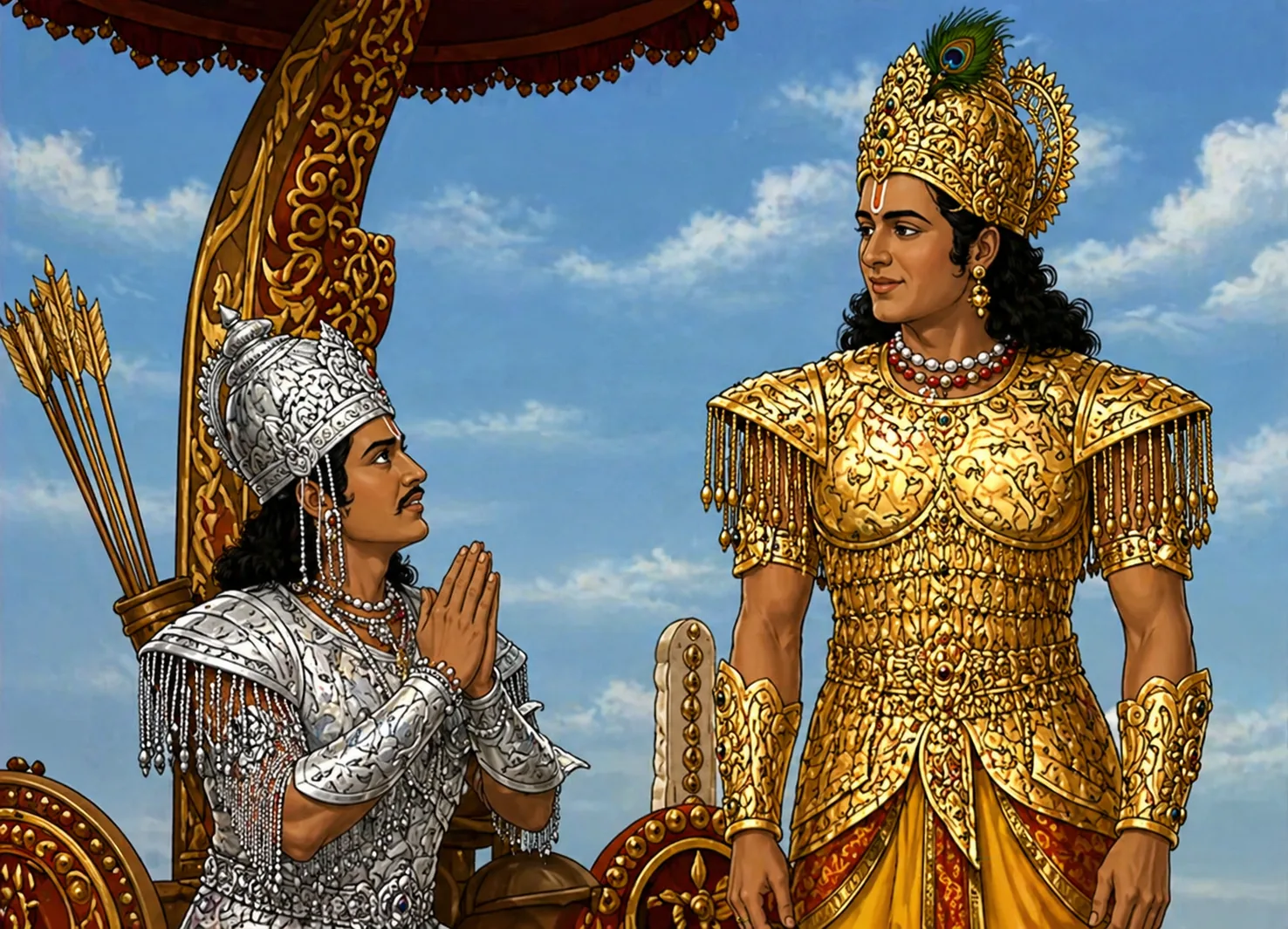
The word sthitaprajna appears for the first time in BG 2.54, when Arjuna asks how to recognize a person of steady wisdom. How do they speak, how do they sit, how do they move? Krishna's response is eighteen consecutive verses, verse 2.55 through verse 2.72.
Arjuna's Question
The question in verse 2.54 is worth quoting before anything else: sthitaprajnasya ka bhasha samadhisthasya kesava. “O Krishna, what is the description of one who has steady wisdom, who is established in samadhi? How does such a person speak? How do they sit? How do they walk?”
The question is concrete. Arjuna wants to know what he would see if he stood next to this person, and what he would hear if they spoke: the outward signs of an inner state.
Krishna's answer works on two levels at once. It describes what the sthitaprajna is like from the outside, and it also serves as a guide for the person who wants to cultivate that state. Each quality is both a description and an instruction.
The compound word itself: sthita means established, rooted, steady. Prajna means wisdom, discernment, the faculty that sees clearly. Sthitaprajna is the person whose discernment is rooted, whose clarity does not come and go with circumstances.
The First Mark: Abandoned Desires
Krishna starts with something inward: what the person has let go of.
आत्मन्येवात्मना तुष्टः स्थितप्रज्ञस्तदोच्यते ॥
ātmanyevātmanā tuṣṭaḥ sthitaprajñastadocyate ||
The word manogatān means “residing in the mind”. The verse locates desire in the mind, and the world keeps offering things to want. What the sthitaprajna has given up is the mind's habit of producing wants by default, which is why the state does not depend on circumstances.
The second half of the verse, ātmany evātmanā tuṣṭaḥ, means satisfied in the self, by the self. The person's sense of being complete needs no outside input, so they can engage with the world without desperation.
The Tortoise (Kachhua) Verse
Three verses later, in 2.58, Krishna compares the steady person to a tortoise (kūrma).
इन्द्रियाणीन्द्रियार्थेभ्यस्तस्य प्रज्ञा प्रतिष्ठिता ॥
indriyāṇīndriyārthebhyastasya prajñā pratiṣṭhitā ||
A tortoise pulls its limbs in when threatened and puts them out again when it is safe. The verse applies that ability to the senses. The yoga tradition calls it pratyāhāra: disengaging attention from sense objects at will.
In practice: someone says something provocative and you feel the pull to react at once. The tortoise skill is noticing that pull, letting it pass, and then choosing whether and how to respond.
The Cascade
After describing the positive qualities of steady wisdom, verses 2.62 and 2.63 describe the opposite: what happens when you do not exercise this withdrawal. Krishna lays out a sequence in which each step follows from the one before.
सङ्गात् संजायते कामः कामात्क्रोधोऽभिजायते ॥
saṅgāt saṃjāyate kāmaḥ kāmātkrodho'bhijāyate ||
स्मृतिभ्रंशाद् बुद्धिनाशो बुद्धिनाशात्प्रणश्यति ॥
smṛtibhraṃśād buddhināśo buddhināśātpraṇaśyati ||
Written out in sequence, the cascade across 2.62 and 2.63 is:
The sequence starts with something that seems harmless: turning an object over in your mind, without doing anything about it. In the Gita's account, desire and anger come later. The chain begins with where you place your attention.
This connects back to the tortoise verse (2.58). Withdrawing attention from an object is an intervention at step one, before steps two through eight can start. By the time you are at anger, much of the cascade has already happened. The time to act is much earlier, at the level of where you are placing your mind.
What Sthitaprajna Is Not
The qualities described across 2.55 to 2.72 are easy to misread as a portrait of someone emotionally flat, someone who has achieved stability by cutting off their emotional range. The verses do not support that reading.
BG 2.56 says the sthitaprajna is not shaken by sorrow and does not crave pleasure, which assumes they meet both. Sorrow reaches them; it does not knock them off their footing.
BG 2.65 gives the clearest counter to the numbness interpretation:
प्रसन्नचेतसो ह्याशु बुद्धिः पर्यवतिष्ठते ॥
prasannacetaso hyāśu buddhiḥ paryavatiṣṭhate ||
The key word in this verse is prasāda, often translated as serenity or grace, with a sense of brightness and clarity. The verse says that once prasāda is established, all sorrow falls away and the intellect settles. That is the outcome of steady wisdom, and it is the opposite of numbness.
The Tortoise and the Ocean
Near the end of the sthitaprajna section, Krishna gives a second extended image. If the tortoise verse describes a capacity (voluntary withdrawal of attention), the ocean verse describes a quality (what that capacity makes possible over time).
तद्वत्कामा यं प्रविशन्ति सर्वे स शान्तिमाप्नोति न कामकामी ॥
tadvatkāmā yaṃ praviśanti sarve sa śāntimāpnoti na kāmakāmī ||
The ocean takes in every river and its level stays the same. Where the tortoise withdraws, the ocean receives: here the sthitaprajna is open to experience, desires arrive, and the person stays steady.
Together, the two images give a more complete picture. The tortoise is about active management of where attention goes: a skill you practice, a choice you make. The ocean is about what that practice builds over time: a settled quality of being that is not disturbed even when you are fully open and engaged.
Steadiness in Ordinary Life
Most people have plenty they want to do. What they often lack is the stability to pursue it without being thrown by outcomes, by other people's reactions, or by not knowing whether it will work out.
When something does not go as expected, there is a habitual question: what does this mean about me? If the result is bad, maybe I am not good enough. If I am not recognized, maybe my effort was worthless. These questions pull you into the chain that 2.62 and 2.63 describe, and the cost is clarity: you lose the ability to think straight about what to do next.
In practical terms, sthitaprajna is the ability to take in a setback or bad feedback without collapsing under it, the way the ocean takes in a river. That steadiness lets you act well when the situation is hard.
All 18 Qualities: Quick Reference
Here is a one-line summary of each verse in the sequence, 2.55 to 2.72:
The sequence has a shape. It begins with the internal condition (let go of desire, be content within), moves to the skills of sense management (the tortoise, the chain from dwelling to ruin, the watchfulness), describes the outcome (prasāda), and closes with the ocean (2.70) and the brahmī sthiti of verse 2.72.
A Note on the Word “Steady”
Prajna is sometimes translated as wisdom, sometimes as intellect, sometimes as discernment. The Sanskrit carries all three: it is the faculty that sees clearly, that distinguishes real from apparent, lasting from temporary. When the Gita calls the sthitaprajna someone whose prajna is established (sthita), it means this faculty of clear seeing is no longer a temporary visitor. It is the stable ground of the person's functioning. Most people have moments of clarity; for the sthitaprajna, clarity is the baseline.
Revised October 2026: corrected the one-line verse summaries to match what each verse says (including 2.55, which no longer adds atman), the order of the tortoise verse (2.58) relative to 2.62, the transliteration of 2.55, and the 2.65 translation; copy edited.