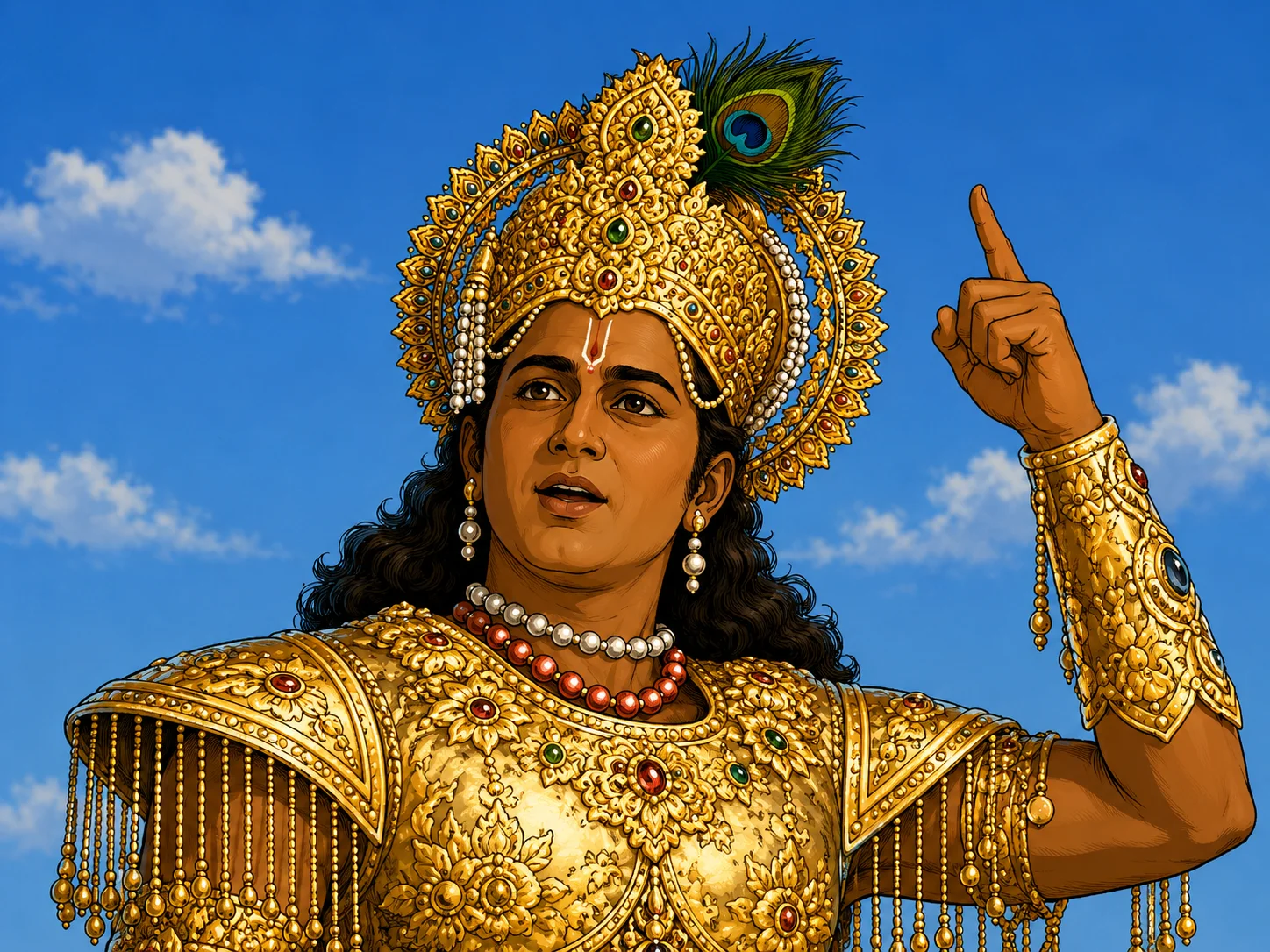
If a single Sanskrit verse were to be counted the most-recited on earth, it would probably be this one. Every morning, in millions of homes across India, in temples in Bali and Nepal, in yoga studios in Los Angeles and Berlin, someone opens the day with twenty-four syllables composed roughly three thousand years ago by a sage named Vishwamitra. And yet if you stopped ten of those chanters and asked them what the mantra actually says, you would likely get ten different answers — and most of them would be wrong.
This is a piece about what the Gayatri Mantra actually says. Not a devotional expansion, not a poster-friendly paraphrase — the words, in the order the sage placed them, and what each of them means. Because when you learn what it really asks for, you will notice that it is asking for something almost no other mantra asks for. And that single fact is what makes it what tradition calls it: the mother of the Vedas.
What you will find in this piece
The mantra itself, in Sanskrit, IAST, Hindi, and English. A word-by-word breakdown of each of the fourteen Sanskrit words. The unusual thing it asks for. The history of its composition. How to chant it, and how many times. Three common misunderstandings, and what the text actually says.
The Mantra Itself
Here is the mantra, complete, with the opening Om and the three vyahritis (bhur, bhuvah, svah) followed by the twenty-four-syllable Gayatri verse from Rig Veda 3.62.10.
तत्सवितुर्वरेण्यं भर्गो देवस्य धीमहि ।
धियो यो नः प्रचोदयात् ॥
tat savitur vareṇyaṃ bhargo devasya dhīmahi |
dhiyo yo naḥ pracodayāt ||
The Structure: Vyahritis, Then the Gayatri Proper
The mantra as it is commonly recited has three parts. Understanding them separately makes the whole thing considerably clearer.
First, Om — the primordial syllable that precedes almost every Vedic mantra. It is not a word so much as the sound-body of the divine itself. In the Mandukya Upanishad, Om is analyzed as the whole of past, present, future, and what lies beyond time.
Second, bhur bhuvah svah — the three vyahritis. These are the names of the three lokas or realms: bhur is the earth (physical), bhuvah is the atmosphere or life-force realm (between), svah is the heaven or luminous realm (beyond). Reciting them is a way of gathering all three worlds into the meditation before the mantra proper begins.
Third, the Gayatri verse itself: tat savitur vareṇyaṃ bhargo devasya dhīmahi — dhiyo yo naḥ pracodayāt. This is the twenty-four syllables of Rig Veda 3.62.10. Every other element is preface. This is the mantra.
Word-by-Word Translation
Below is each Sanskrit word in the order it appears, with its meaning. Fourteen words. Read them slowly — the mantra is short enough that carrying the meaning of every word is genuinely possible.
- Om (ॐ) — the primordial sound. Not a word with a lexical meaning; it is the sonic form of the absolute. Every Vedic mantra opens with it.
- Bhur (भूः) — the earth realm. Physical existence, the body, the material plane. The first of the three vyahritis.
- Bhuvah (भुवः) — the atmospheric realm, the life-force (prana), the space between earth and heaven. The second vyahriti.
- Svah (स्वः) — the heavenly realm, the luminous plane, the beyond. The third vyahriti.
- Tat (तत्) — “that.” A pronoun of reverent distance, used to point at the divine without naming it. The same tat appears in the great Upanishadic saying tat tvam asi — “you are that.”
- Savitur (सवितुः) — “of Savitri.” Savitri is not the visible sun. It is the divine principle of enlivening, the source that impels the sun to shine. The name comes from the root su, meaning “to impel” or “to bring forth.”
- Vareṇyam (वरेण्यं) — “most worthy of adoration,” “most excellent,” “that which is to be chosen.” From the root vṛ, “to choose.”
- Bhargo (भर्गो) — brilliant effulgence, the burning splendour, the destroyer of ignorance. Bhargo is not gentle light. It is fire that consumes darkness.
- Devasya (देवस्य) — “of the divine,” “of the shining one.” From div, “to shine.”
- Dhīmahi (धीमहि) — “we meditate on.” First-person plural, cohortative. Not “I” but we. The Gayatri is a communal meditation, never a private one.
- Dhiyo (धियो) — “the intellect,” “the understanding,” “the discerning faculty of mind.” From dhī, the same root as dhīmahi. This is what the mantra asks to have illumined.
- Yo (यो) — “who,” “which.” A relative pronoun referring back to the divine Savitri.
- Naḥ (नः) — “our.” Again communal. Not my intellect. Our intellect.
- Pracodayāt (प्रचोदयात्) — “may it inspire,” “may it propel forward,” “may it awaken.” From the root cud, “to impel.” The optative mood makes it a prayer, not a demand.
Read as a single sentence: We meditate on that most-adorable brilliant splendour of the divine Savitri — may he inspire our understanding. That is the whole ask.
What the Mantra Is Actually Asking For
Notice what is missing from that translation. There is no request for wealth. No request for health. No request for protection from enemies. No request for a good spouse, or many sons, or safe travel, or long life. All of these are standard requests in Vedic hymns; the Rig Veda is full of them. The Gayatri asks for none of them.
It asks for one thing: that the divine light illumine our dhī — our intellect, our understanding, our capacity to discern. Not that we be given the right answer. That we be given the light by which we can see the right answer for ourselves. This is a philosophically precise ask, and it is philosophically unusual.
Most prayers, in most traditions, ask for a specific outcome. The Gayatri asks for the faculty by which one can navigate any outcome. Give me not the fish, but the light by which I can see the water. This is why traditional commentators call it the mother of all mantras: every other legitimate ask presupposes an intellect illumined enough to know what to ask for.
The unusual ask
The Gayatri does not ask for wealth, health, protection, or salvation. It asks only that the divine light quicken the intellect — the faculty by which every other question can be answered. This is why it is called the mother of the Vedas.
The Sun in the Gayatri Is Not the Sun
One of the most common misreadings of the Gayatri is that it is a sun-worship mantra. It is not. The Sanskrit word is Savitri, not Surya. Surya is the name of the visible sun, the disc in the sky. Savitri is something different — the divine principle of impelling, of bringing forth, of enlivening. Savitri is what makes the sun shine, not the sun itself.
The distinction matters. If the Gayatri were simply a sun-worship verse, its meaning would collapse the moment you stepped indoors or the sun went behind a cloud. But Savitri is not weather-dependent. Savitri is the source of all light — the light of the sun, yes, but also the light of consciousness, the light of understanding, the light by which anything is seen at all.
The visible sun is Savitri's most accessible metaphor. It is the thing everyone can point to and say that is what illumination looks like. But the mantra addresses the source of which the sun is only the sign. Sri Aurobindo, in his commentary, called Savitri the “creator of the truth-consciousness.” That is closer to what the sage actually means.
History and Tradition
The Gayatri sits in the third book of the Rig Veda, verse 3.62.10 — one of the oldest sections of one of the oldest books in the world. It is attributed to the sage Vishwamitra, the same rishi whose transformation from king to sage is one of the great narratives in Vedic literature. He was, tradition says, once a warrior who out of pride tried to defeat the sage Vasishtha, failed, and turned instead to austerity. The Gayatri is his gift.
The verse is composed in the Gayatri meter, from which it takes its name. The Gayatri meter has three padas or lines of eight syllables each — twenty-four syllables total. When Vedic tradition calls this verse the Gayatri, it means: the Gayatri-metered verse so foundational that its meter has become its name.
Traditionally, the mantra was formally transmitted to a boy at his upanayana, the sacred-thread ceremony that marked his entry into Vedic study. The teacher whispered the mantra into the student's ear, and from that moment onward the student was expected to recite it three times a day — at sunrise, noon, and sunset — for the rest of his life. This practice is called Sandhya vandana: worship at the junctures of the day.
Historically, this transmission was restricted to the three “twice-born” varnas — brahmana, kshatriya, vaishya — and to males within them. But the verse itself sits openly in the Rig Veda, has been transcribed and printed for centuries, and has never actually been secret. Modern reformers — Swami Dayananda Saraswati of the Arya Samaj, Swami Vivekananda, and later Sri Aurobindo — argued that the mantra's restriction was a social accretion, not a scriptural one, and that its blessing was universal. Their view has largely prevailed. Today the Gayatri is chanted by women and men of every background, and the argument for universal access is settled in almost every serious modern school.
Two commentaries worth knowing
Swami Vivekananda taught the Gayatri throughout his American lectures, calling it “the essence of the Vedas.” His argument was straightforward: any teaching that asks only for the illumination of the intellect cannot rationally be restricted by birth. Sri Aurobindo devoted a substantial part of his Hymns to the Mystic Fire and The Secret of the Veda to unpacking Savitri as the truth-consciousness, arguing that the mantra was the seed of the whole integral yoga.
How to Chant It: A Practical Guide
The Gayatri rewards technique. Below is the traditional method, stripped of the parts that no longer travel well.
- Start with pronunciation. The Sanskrit sounds matter. Learn the IAST guide above and, if possible, listen to a Vedic reciter before you begin. The dentals (t, d), the retroflex (ṇ), the long vowels (ā, ī), and the sibilants (ṣ, ś) each carry the meaning. If your pracodayāt becomes prachodayat, you have said something adjacent but different.
- Begin with 3 or 11 recitations. Do not start with 108. Start with three careful, correctly-pronounced repetitions, done every morning for a month. Then move to eleven. The tradition is patient with beginners.
- Work up to 108. The traditional daily practice is 108 recitations — one full mala. The number is symbolic (108 has meanings across every Indic tradition) and practically useful: it is roughly the length at which the mind stops resisting and settles into the rhythm.
- Chant at the Sandhya times. Sunrise, noon, sunset — the three sandhis or junctures. These are the hinge moments of the day, when light itself is transforming. If you can only do one, sunrise is the traditional choice.
- Focus on meaning during the last third. For the first sixty or seventy recitations, let the sound do the work. In the last third, let the meaning come forward. May the divine light illumine our understanding. Hold that ask consciously.
- Consistency over intensity. Ten recitations a day for a year will do far more than 108 recitations abandoned after a week. The Gayatri is a long practice. Treat it that way.
Benefits — What Practitioners Report
A brief note on benefits, because they are often overclaimed. Traditional texts attribute vast powers to the Gayatri — purification of karma, awakening of kundalini, protection from all harm. Modern practitioners report something more measured, and the measured report is what is worth passing on.
The most consistent report is clarity before decisions. People who chant the Gayatri daily for months describe a settled quality to the morning — a sense that the day begins with a small pocket of stillness that carries into the first meeting or the first difficult conversation. This is unsurprising: a five-to-fifteen-minute meditation on a single meaningful phrase, done daily, will produce measurable effects on attention and equanimity in any tradition.
Beyond that: the discipline of ritual (having something you do every morning, regardless of mood), the community connection (chanting the same mantra that millions of others chant at the same time), and the sense of continuity with a very old lineage. These are real benefits. Whether they are “spiritual” or “psychological” is a question the Gayatri itself does not require you to settle.
Three Common Misunderstandings
Misreading 1: “It is a sun-worship mantra”
It is not. The mantra addresses Savitri — the divine principle of enlivening — not Surya, the visible sun. The sun is the metaphor because it is the most accessible source of light we can point to, but the ask is directed at the source of which the sun is only the sign. Reading the Gayatri as sun worship is like reading a love letter as a description of the paper it was written on.
Misreading 2: “It grants material wishes”
This is popular in modern devotional literature and it is textually indefensible. The mantra asks for exactly one thing: the illumination of the intellect. It does not ask for wealth, health, a good spouse, or the removal of enemies. Devotional traditions have added those meanings on top of the text, but the text itself is precise. What it grants is the faculty by which one can navigate one's life — not the specific outcomes of it.
Misreading 3: “You need a guru to receive it”
Traditionally, yes, the mantra was transmitted by a teacher at the upanayana ceremony, and there are still lineages where formal diksha (initiation) is considered essential. But the verse itself sits in the public Rig Veda, has been printed in every serious edition of the text for centuries, and has been publicly taught by Vivekananda, Aurobindo, Dayananda, and every modern reformer of note. If you have access to the mantra, you have access to the practice. A teacher deepens; the absence of one does not disqualify.
The Gayatri Beyond the Gayatri
One last thing worth mentioning. The Gayatri meter has been used for other mantras addressed to other deities — the Ganesha Gayatri, the Krishna Gayatri, the Durga Gayatri, the Shiva Gayatri, and many more. Each follows the same 24-syllable structure across three padas of eight, and each ends with some variant of tanno [deity] pracodayāt — “may that [deity] inspire us.”
These are not the Gayatri. They are Gayatri-metered mantras. When tradition calls this verse the Gayatri — the mother of the Vedas, the seed mantra — it means the original: Rig Veda 3.62.10, Vishwamitra's hymn to Savitri, the twenty-four syllables that ask only that the divine light quicken our understanding. Everything else is descended from it.
If someone asks you for the Gayatri's meaning in one sentence
May the divine source of all light — of which the sun is only the visible sign — illumine our understanding. That is the whole of it. Everything else is commentary.