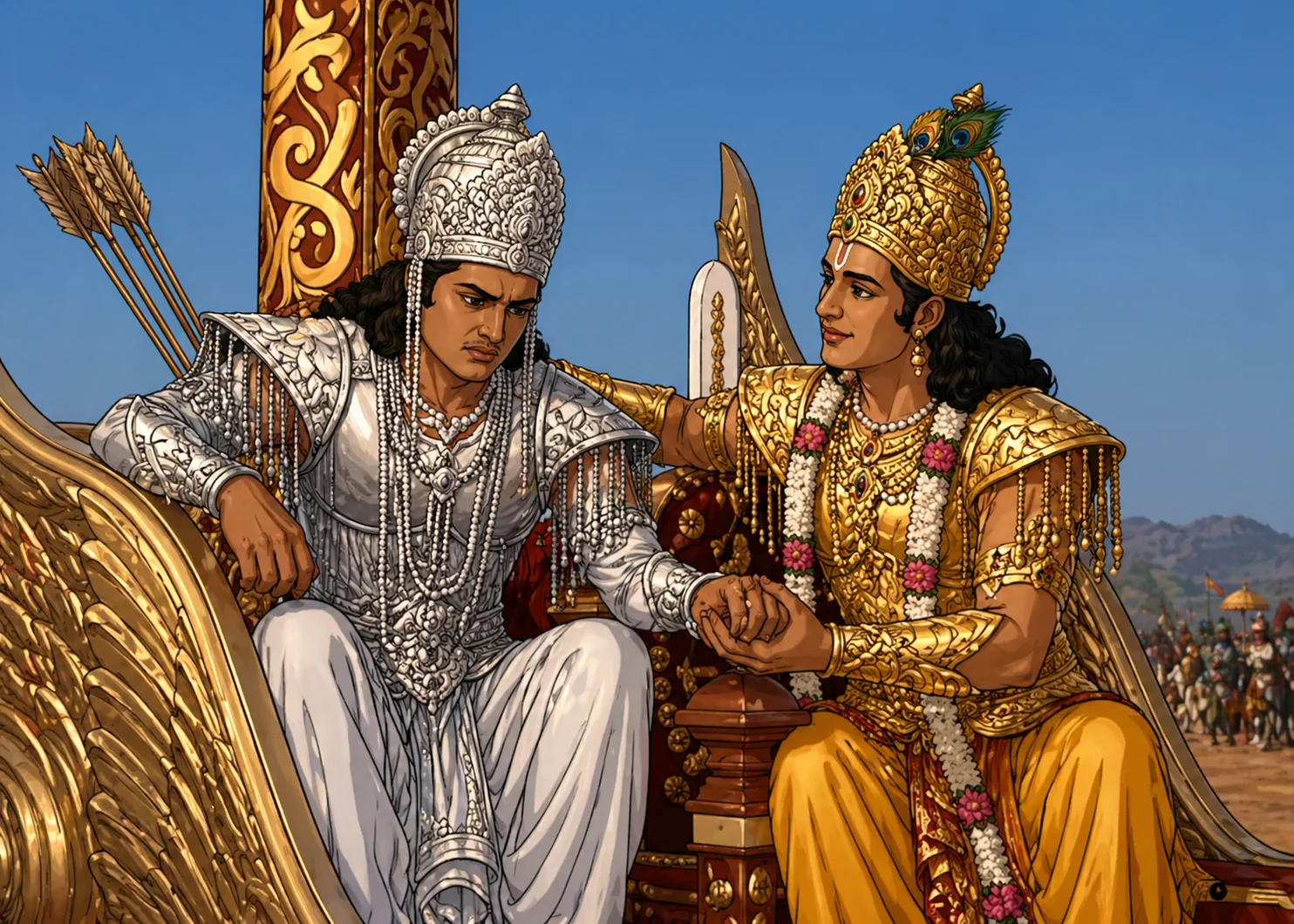
The word dharma comes from the Sanskrit root dhr, to hold or sustain. Dharma is what holds. What maintains the structure of things. It is the nature of water to flow downward. It is the nature of fire to burn upward. That is dharma. The Gita uses the word in at least four different registers, and most of the confusion about what it means comes from collapsing all four into one.
Why “Duty” Is the Wrong Translation
The standard English rendering of dharma is “duty,” and it causes real damage to the text. Duty implies an external obligation: something imposed from outside, a rule you must follow, a role assigned to you by someone else. If you perform your duty, you have done what you were told. If you shirk it, you have failed.
Dharma works differently. A fire's dharma is to burn upward. This is not a rule imposed on fire. It is a description of fire's nature. Fire that burned downward would not be failing its duty. It would be a different kind of thing entirely, or nothing at all. The dharma of a thing is what that thing genuinely is, expressed in action.
For a person, this gets more complex. Dharma is not static. It shifts with role, stage of life, circumstance. But at its core, the Gita is asking: what does your actual nature require of you? That is closer to dharma than any external obligation is.
The Four Registers of Dharma in the Gita
Sanatana dharma is universal moral and cosmic order, the laws that hold the universe in coherence. Rita dharma is the rhythm of natural law. Varna dharma is role-based duty tied to social function and stage of life. Svadharma is the dharma specific to you, arising from your own nature and not transferable to anyone else.
The Gita is interested in all four but most urgently in the last one. Arjuna's crisis is a svadharma crisis. And Krishna's answer is a svadharma answer.
Sanatana Dharma vs. Svadharma
Sanatana dharma is sometimes translated as “eternal religion” or “universal law.” It describes the underlying moral structure of the cosmos, the principles that apply regardless of time, place, or person. Honesty is part of sanatana dharma. Non-cruelty is part of sanatana dharma. These are not negotiable on the basis of circumstance.
Svadharma is different. It is specific. It is yours. The Gita's word for your own nature is svabhava, and svadharma flows from svabhava. If your svabhava tends toward precision, care, and structure, your svadharma probably looks different from someone whose svabhava tends toward boldness, confrontation, and leadership. Same cosmic order. Different individual expressions.
The tension the Gita keeps returning to is between these two: what does your individual nature require, versus what does the universal order require? In most cases they align. When they appear to conflict, the Gita's instruction is usually to go deeper into svadharma, not to abandon it for a borrowed version of virtue.
BG 3.35: Better Your Own Path, Imperfect
The clearest statement of svadharma in the Gita comes in Chapter 3. It is blunt. It admits imperfection. It does not promise that walking your own path will produce better results.
स्वधर्मे निधनं श्रेयः परधर्मो भयावहः ॥
svadharme nidhanaṃ śreyaḥ paradharmo bhayāvahaḥ ||
This is striking in a culture that values visible success. The verse is not measuring outcomes. It is measuring the quality of the life from the inside. A life spent performing another's dharma well produces a particular kind of interior damage: you become skilled at something that was never yours, and you live in constant low-level fear of the gap between your performance and your actual nature.
Dharma as the Battleground: BG 1.1
The Gita's very first word is dharmakshetra: the field of dharma. The battlefield at Kurukshetra is named this way. The choice is deliberate. What is about to happen is not simply a war over territory or inheritance. It is a confrontation over dharma itself.
Dhritarashtra's question at the opening — what did the sons of Pandu and my people do on the dharma-field? — is not merely logistical. He is asking: on the field where dharma gets decided, who is standing and who is falling? The answer he will receive is the entire Bhagavad Gita.
The setting matters because it locates the Gita's teaching in the most extreme version of a dharma crisis. Arjuna is a warrior. His role, his training, his entire life up to this moment have been preparation for this kind of situation. And at the moment of actual combat, he puts down his bow. This is not cowardice in the ordinary sense. Arjuna is fully capable of fighting. He is refusing because he cannot see his way to a dharma that covers what he is being asked to do.
When Dharma Declines: BG 4.7 and 4.8
Chapter 4 introduces the cosmic dimension of dharma. Krishna describes a pattern that operates across ages: dharma declines, adharma rises, and Krishna takes form to restore the balance.
अभ्युत्थानमधर्मस्य तदाऽऽत्मानं सृजाम्यहम् ॥
abhyutthānamadharmasya tadā''tmānaṃ sṛjāmyaham ||
धर्मसंस्थापनार्थाय संभवामि युगे युगे ॥
dharmasaṃsthāpanārthāya saṃbhavāmi yuge yuge ||
These two verses are frequently quoted as comfort in difficult times: things are bad, but correction will come. That reading is not wrong, but it is incomplete. The verses are also making a structural claim about how the cosmos works. Dharma is not self-sustaining. It requires both human effort and something beyond human effort. Both are real and both are necessary.
BG 18.47: The Teaching on Svadharma, Restated
The teaching from BG 3.35 is essentially repeated in Chapter 18 at a higher register. By the time we reach Chapter 18, Arjuna and the reader have been through the full arc of the Gita. The restatement here is not accidental. It is the Gita confirming that this teaching belongs at both the beginning and the end of the path.
स्वभावनियतं कर्म कुर्वन्नाप्नोति किल्बिषम् ॥
svabhāvaniyataṃ karma kurvannāpnoti kilbiṣam ||
The difference between BG 3.35 and BG 18.47 is in the framing. In Chapter 3, the teaching is framed against the danger of paradharma. In Chapter 18, it is framed positively: act from svabhava, and you are protected. The teaching has moved from warning to affirmation. After 15 chapters of instruction, the Gita is saying: this is still it. This is the core of what I was saying from the beginning.
The Surrender: BG 18.66
The last teaching of the Gita appears to contradict everything that came before. After spending 17 chapters building the case for dharma, svadharma, and right action, BG 18.66 says: abandon all dharma. Come to me alone.
अहं त्वा सर्वपापेभ्यो मोक्षयिष्यामि मा शुचः ॥
ahaṃ tvā sarvapāpebhyo mokṣayiṣyāmi mā śucaḥ ||
This verse is sometimes used to argue that the Gita ultimately dismisses all ethical frameworks as obstacles to pure devotion. That reading requires ignoring the 700 verses that precede it. The verse is not canceling the dharma teaching. It is describing what happens at its completion. You do not arrive at surrender by skipping the work of dharma. You arrive at it by doing that work until the clinging to it as personal achievement falls away.
Dharma in Practice: What Arjuna's Dilemma Teaches
Arjuna's specific crisis at the opening of the Gita is a collision between two dharmas. As a kshatriya (warrior), his role-dharma is to fight a righteous war. As a family member, his relational dharma is loyalty and affection toward his own people. Both are real. Both are legitimate. And they are pointing in opposite directions.
Krishna's answer is not to resolve the collision by declaring one dharma superior to the other. He goes deeper. He moves the question from role-based dharma to the level of the atman itself. Once Arjuna understands what he actually is (and what cannot be killed), the collision between warrior-dharma and family-dharma does not disappear, but it is seen from a different vantage. The action required by his position and nature becomes clear, not because the conflict was resolved, but because the framework expanded.
This is the Gita's model for navigating dharma conflicts: go deeper, not sideways. When two dharmas collide at the role level, look for what your svadharma requires at the level of actual nature, not performed function.
What “Follow Your Dharma” Actually Means
The phrase has become a kind of wellness-culture slogan, meaning roughly “follow your passion” or “live authentically.” The Gita's version is harder than that.
Svadharma Is Not a Career
Svadharma is not what you enjoy doing. It is not what makes you feel good. It is what your nature requires of you, which sometimes means doing difficult things you would rather avoid, in the way that only you can do them, without borrowing someone else's method or measuring yourself against someone else's standard.
Arjuna did not want to fight. His svadharma required it anyway. The Gita is not saying do what feels right. It is saying act from what you actually are. These sometimes align and sometimes cost considerably.
The Gita's final position on dharma is something like this: understand what you are. Act from that understanding. Let the fruits go where they go. Do not pretend to be something you are not in order to perform someone else's dharma more impressively. And at the end of all of that, when the teaching has gone as deep as it can go, arrive at the place where even the architecture of dharma is held lightly, because what is underneath it is bigger than any framework can contain.
This is the actual scale of the Gita's teaching on dharma. It is not a rule. It is a direction. And the direction is always inward.