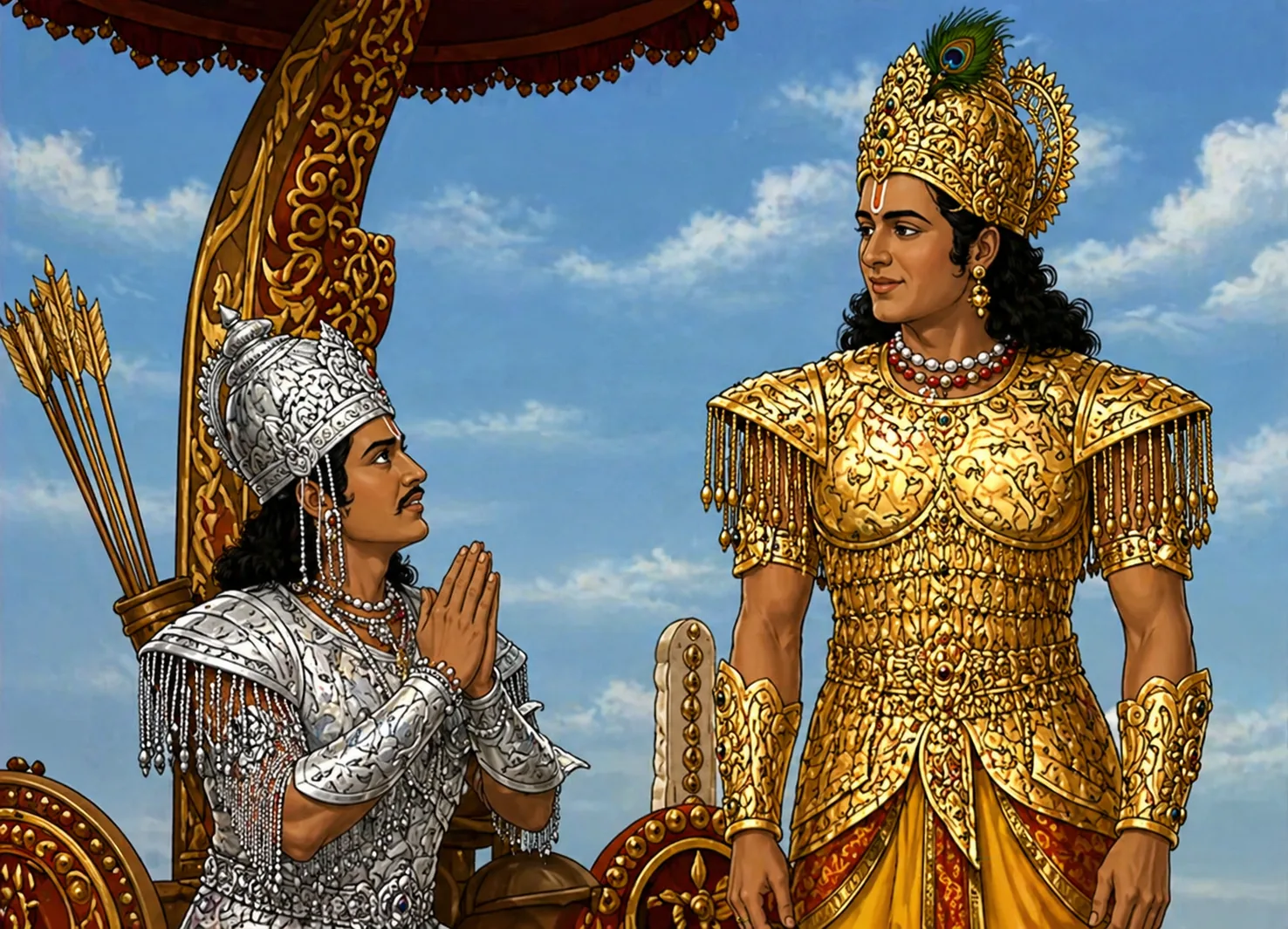
Krishna's first words to the weeping Arjuna are a rebuke: give up this weakness of heart and stand up (2.2–3). When Arjuna still refuses to fight, Krishna begins his teaching in 2.11 with a claim: the people Arjuna is grieving for cannot be killed. Much of what follows in the Gita builds on it.
What Is the Atman?
Chapter 2 uses three words close together. The sharira (also deha) is the body, which is born, ages and dies. The dehi is “the embodied one”, the one who lives in the body. The atman is the self. In these verses the dehi and the atman are the same thing seen from two sides: dehi names the self as it lives in a body, atman names it as it is.
Krishna separates the self from everything that can be harmed. The body can be cut, burned and destroyed. The self passes from body to body (2.13, 2.22) and is itself unborn, unchanging and without end (2.20, 2.24).
BG 2.13 starts with an everyday example: the body already passes through great change, and nobody says the person died along the way.
तथा देहान्तरप्राप्तिर्धीरस्तत्र न मुह्यति ॥
tathā dehāntaraprāptirdhīrastatra na muhyati ||
The Gita's argument about death begins here, with no promise about heaven or reunion. You have already lived through great change, and what you are has persisted through it. Krishna puts the death of the body in the same class of change.
The Four Negatives: BG 2.23
Verse 2.23 is the one people quote on this subject. It is often quoted on its own, but it comes in the middle of an argument Krishna has been building since 2.16. Here he puts it as four negations.
न चैनं क्लेदयन्त्यापो न शोषयति मारुतः ॥
na cainaṃ kledayantyāpo na śoṣayati mārutaḥ ||
The verse that follows, 2.24, continues the description. The atman is acchedya (cannot be cut), adahya (cannot be burned), akledya (cannot be wet), and ashoshya (cannot be dried). It is nitya (perpetual), sarvagatah (all-pervading), sthanuh (stable), achala (unmoving) and sanatana (eternal). Each word adds something. Together they describe something that is everywhere, stays still, has no end, and lies beyond the reach of any physical force.
The Eternal, the Unchanging: BG 2.20
BG 2.20 states the point directly. It comes before 2.23 and sets out the terms that 2.23 then applies.
अजो नित्यः शाश्वतोऽयं पुराणो न हन्यते हन्यमाने शरीरे ॥
ajo nityaḥ śāśvato'yaṃ purāṇo na hanyate hanyamāne śarīre ||
The four adjectives are worth taking one at a time. Aja means unborn. Nitya means eternal, always existing. Shashvata means everlasting. Purana means ancient, or primeval. Together they describe something that was never created and cannot be destroyed, since creation and destruction apply to things that come into existence and leave it.
The Old Clothes Analogy: BG 2.22
The plainest image the Gita gives for the dehi moving on is the clothes analogy in 2.22. People often quote it when talking about rebirth, and it needs no background in philosophy.
तथा शरीराणि विहाय जीर्णान्यन्यानि संयाति नवानि देही ॥
tathā śarīrāṇi vihāya jīrṇānyanyāni saṃyāti navāni dehī ||
The analogy has a limit. “The same person in different clothes” usually means the same face, voice and memories. The Gita claims less: what continues is the dehi. In 15.8 the self carries the mind and senses to a new body as the wind carries scent, and the verse does not say whether personal memory goes along.
What Krishna Says About Grief
Krishna does tell Arjuna to stop grieving. He opens in 2.11 with “you grieve for those who should not be grieved for”, and he repeats “you should not grieve” in 2.25, 2.27 and 2.30. His method is argument: he gives Arjuna a different picture of what is happening, so that the grief has no false premise to rest on.
A Claim About the Self
The Gita's claim is that the atman is eternal. For someone grieving today, that claim does not make the loss of a particular face, a particular person you loved, easy to bear, and the Gita never promises that it will.
A condolence card says “they are at peace now.” Krishna says that what they were was never in danger. The second statement is harder to hear when someone you love has died.
Impermanence and What Changes: BG 2.14
BG 2.14 comes just before the main atman verses and gives the other side of the picture. The body and the world of experience are impermanent. Contact with the external world produces heat and cold, pleasure and pain. These come and go. The instruction is to bear them without being defined by them.
The verse accepts that loss is real and that experience comes and goes. Two verses later, 2.16 says that what is unreal has no being and what is real never ceases to be. The changing layer of experience is one thing; the one who experiences it is another.
The body belongs to the changing layer, and the atman to the other. The Gita draws that line without saying that nothing matters.
What Happens After Death: BG 15.7
The Gita returns to the question of what continues in Chapter 15. BG 15.7 says that every living being in this world is an eternal portion of Krishna, which draws to itself the mind and the five senses.
मनःषष्ठानीन्द्रियाणि प्रकृतिस्थानि कर्षति ॥
manaḥṣaṣṭhānīndriyāṇi prakṛtisthāni karṣati ||
Chapter 8 says more about what shapes the next birth: whatever state a person remembers at the end, to that state they go (8.6). The Gita gives no detailed map of the afterlife. It gives a direction: the dehi continues, shaped by what it has been attached to, and the aim is to loosen that attachment.
How This Bears on How You Live
The Gita spends little time on whether there is life after death. Its question is how to live once you accept that the atman is eternal.
If you are the atman, then comfort for the body is only part of what is worth working for, and you can ask what serves the self as well as what serves the body.
The Gita still expects you to look after the body. Its question is where you place your sense of who you are. A sense of self built only on the body rests on something that will end. Holding the body as the dehi's present garment changes how a person meets loss and aging.
Why the Rest of the Gita Needs This
Much of the Gita's later teaching assumes this one. Karma yoga asks you to act without attachment to results, which is hard to justify if the body's comfort and survival are all that is at stake. Bhakti, in 15.7, rests on the self being a part of Krishna.
Fear of death and grief stay with a person who accepts this teaching. Krishna adds that they are not the last word on what has happened.
Revised October 2026: corrected the account of dehi and atman (in 2.13–2.22 the dehi is the atman, embodied), the glosses of sanātana (eternal), purāṇa (ancient) and śāśvata (everlasting), the translations of 2.13 and 15.7, the elements in 2.23, and the claim that Krishna does not tell Arjuna to stop grieving (see 2.11, 2.25); copy edited.