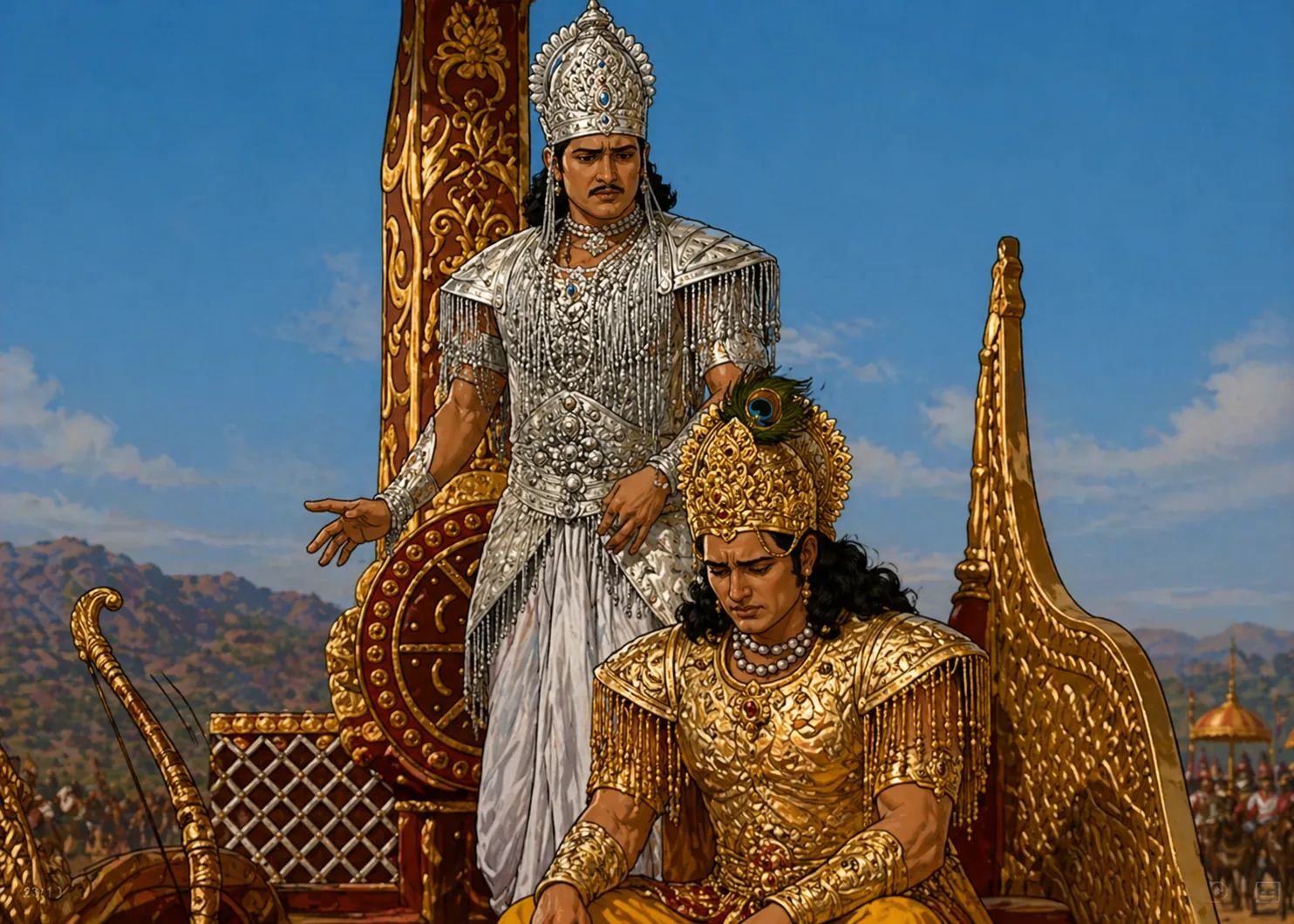
The Bhagavad Gita begins on a battlefield. Arjuna looks across at teachers, cousins and elders he has known all his life, and his body gives way: his limbs fail, his mouth dries, his skin burns and his bow slips from his hand (1.29–30). At the end of chapter 1 he sits down in the chariot, overcome with grief (1.47). In 2.7 he admits he no longer knows what is right and asks Krishna to teach him.
Krishna never tells Arjuna that everything will be fine. Over the next seventeen chapters he explains where the disturbance comes from, how the mind builds it, what lets it settle, and what a steady person looks like.
Arjuna in Chapter 1
Arjuna is a famous archer, the man who won Draupadi's hand by hitting a target few could reach. The people arrayed against him include his teacher Drona and his grandfather Bhishma. He has asked Krishna to drive the chariot between the armies so he can see them, and he does.
His body fails first: limbs, mouth, skin, the grip on his bow. Then his reasons pile up. He says he wants no victory, kingdom or pleasure bought with his kinsmen's lives (1.32), and that killing them will destroy families and their traditions (1.39–44).
The Gita is sometimes read as abstract philosophy, but every chapter after this one is addressed to the man sitting in that chariot.
Bearing What Passes: 2.14
One of Krishna's first teachings points Arjuna to how sensations behave.
आगमापायिनोऽनित्यास्तांस्तितिक्षस्व भारत ॥
āgamāpāyino'nityāstāṃstitikṣasva bhārata ||
Titiksha means to bear something with patience. The fear is allowed to be there; Arjuna is asked to carry it without being carried off by it.
The Cascade from Attachment to Ruin
In 2.62–63 Krishna describes how the mind moves from dwelling on something to losing its judgment entirely. Each step follows from the last.
From Dwelling to Ruin (BG 2.62–63)
Krishna states the chain about desire and anger in general, but it fits Arjuna in chapter 1. He has been dwelling on the faces across the field and on what the battle will cost. By 2.7 he says his mind is confused about dharma. Much of the dialogue that follows is Krishna restoring his buddhi so he can decide.
प्रसन्नचेतसो ह्याशु बुद्धिः पर्यवतिष्ठते ॥
prasannacetaso hyāśu buddhiḥ paryavatiṣṭhate ||
न चाभावयतः शान्तिरशान्तस्य कुतः सुखम् ॥
na cābhāvayataḥ śāntiraśāntasya kutaḥ sukham ||
You Are Your Own Friend and Enemy
Worry often feels like something that happens to you. In chapter 6 Krishna puts the responsibility for lifting the mind on the person who has it.
आत्मैव ह्यात्मनो बन्धुरात्मैव रिपुरात्मनः ॥
ātmaiva hyātmano bandhurātmaiva ripurātmanaḥ ||
The verse is about agency. The same mind that produces worry can produce steadiness, and in the Gita's framing a person can both lose and recover their own clarity.
Prasada: What the Gita Calls Serenity
The word prasada appears in BG 2.65 and is often translated as serenity or grace. In 2.64 it is what comes to a person whose senses are free of attraction and aversion. When craving and aversion both settle, what remains is prasada.
BG 12.15 describes a person who has that kind of steadiness.
हर्षामर्षभयोद्वेगैर्मुक्तो यः स च मे प्रियः ॥
harṣāmarṣabhayodvegairmukto yaḥ sa ca me priyaḥ ||
Krishna Agrees the Mind Is Hard: 6.35
In 6.33–34 Arjuna complains that the mind is restless and as hard to hold as the wind. Krishna agrees with him.
अभ्यासेन तु कौन्तेय वैराग्येण च गृह्यते ॥
abhyāsena tu kaunteya vairāgyeṇa ca gṛhyate ||
Abhyasa means returning to the practice again and again. Vairagya means loosening the grip of craving. Krishna makes no promise about speed.
Two Common Misreadings
Two misreadings make the teaching seem either impossible or useless.
Steady Is Different from Unfeeling
Krishna does tell Arjuna that he grieves for those who should not be grieved for (2.11). His argument is about the reasons for the grief, and the instruction in 2.14 is to bear what comes and goes.
The steady-minded person in BG 2.56 stays unshaken in sorrow and free of craving in pleasure. A mind that sorrow cannot shake is one that still meets sorrow.
Arjuna also takes a long time to move from grief to action. Krishna answers his arguments over many chapters before Arjuna says his confusion is gone (18.73).
On the Specific Anxiety About Outcomes
Much everyday worry is about outcomes: whether something will work, and what people will think if it fails. The Gita speaks to this directly.
BG 2.47 says your right is to the action, never to its fruits. Outcomes still matter. The trouble starts when the expected result becomes the reason for acting and the measure of your worth, because then you depend on something you cannot fully control, and the work turns into constant checking on whether the result is still on track.
BG 2.38 gives the instruction: treat pleasure and pain, gain and loss, victory and defeat alike, and then fight. Krishna is asking for an even mind while acting, which lets Arjuna act without being ruled by what might happen.
ततो युद्धाय युज्यस्व नैवं पापमवाप्स्यसि ॥
tato yuddhāya yujyasva naivaṃ pāpamavāpsyasi ||
Samatva has to be practised. Krishna does not promise that Arjuna will feel fine at once. He gives him a different way to hold the situation and then spends the rest of the Gita giving the reasons for it.
At the end, Arjuna says his delusion is gone, his memory restored, and that he will do as Krishna says (18.73). He is the same man who sat down in chapter 1. What has changed is how he understands what he is about to do.
Revised October 2026: corrected the claim that Krishna does not tell Arjuna to stop grieving (see 2.11), narrowed the dwelling-to-ruin chain to 2.62–63, removed details not in 1.28–30, corrected the translations of 2.38, 2.65 and 12.15, and removed medical framing; copy edited.